
Contents:
- Where to start saving money?
- What is a safety cushion and why is it so important?
- How to save money quickly?
- How to save correctly?
- Set SMART goals
- Expense analysis
- Expense optimization
- Income analysis
- Optimize income
- Mistakes that hinder Save
- How to save on a low income?
- How to save on an average income?
- How to save on a high income?
- Where to keep savings?

Free test: which digital profession is right for you? Find out the answer in 15 minutes and try your hand at a new specialty.
Learn moreWhere to start saving money?
Starting savings is always associated with a clear definition of the goal. Choosing a specific goal helps focus efforts and motivation, which significantly increases the chances of successfully achieving financial results. By defining your goal, you can plan a budget and choose the right savings tools. This could range from purchasing real estate to creating a financial cushion in case of unforeseen circumstances. It's important to remember that having a clear goal not only simplifies the savings process but also makes it more conscious.
When talking about saving skills as a goal-oriented process, it's important to start with creating a financial cushion. This is a reserve fund that will help cope with unexpected expenses and ensure financial stability. Creating such a cushion requires planning and discipline. Start by determining the amount that will serve as your financial reserve and gradually put money into this account. This approach will not only protect you from financial difficulties but also allow you to feel comfortable in unstable situations.
What is a safety cushion and why is it so important?
A financial cushion is a monetary reserve created to cover unexpected expenses. Having such a cushion provides financial security during difficult times. Funds from a financial safety net can be used for medical expenses, educational expenses, appliance repairs, and to maintain a stable standard of living in the event of a loss of primary income. Creating and maintaining a financial reserve is an important step toward ensuring financial independence and future security. Many people are reluctant to create a financial safety net, viewing it as unnecessary or secondary. They believe that in the event of an unforeseen circumstance, they can turn to friends or family for help or take out a loan. However, such approaches are not optimal and can lead to an increase in debt. A financial safety net helps reduce stress and provide protection in difficult situations, allowing you to avoid dependence on external sources of financing. Creating an emergency fund is a conscious and responsible decision that promotes financial stability and future security. Before applying for a loan, you must ensure that you have sufficient available funds for regular payments. This will help avoid financial difficulties and ensure the stability of your budget. Responsible budgeting and understanding your financial capabilities play a key role in successfully managing credit obligations.
According to a study by the auditing company FinExpertiza, the average time to find a new job is approximately six months. Therefore, financial experts recommend having a reserve amount equal to six monthly salaries. However, if you are employed stably, the financial cushion can be reduced to three salaries. Creating a financial reserve helps reduce stress during the job search and provides greater financial security.
Before creating a cash reserve, it is important to determine whether it will be a hard or flexible instrument. A hard reserve is designed for unexpected expenses and financial security, while a flexible reserve allows for more flexibility in financial management, adapting to changing circumstances. Assess your financial goals and risks to choose the most suitable option for you.
- Hard instrument. You decide that you will use these savings only in the event of job loss. For all other unexpected situations, start another savings bank.
- A flexible tool. You decide that you can take money from this savings category for a wider list of expenses. But strictly limit this list. Consider what would cost you money if something unexpected happened. You can take into account emergency health problems (yours and those of close relatives), repairs to work tools (for example, a computer if you work from home), and paying off loans.
Both options are acceptable. The main thing is your comfort.
You don't have to put all your available funds into an emergency fund; you can save in several directions simultaneously. For example, if you have 20,000 rubles of free money per month, at the first stage of savings it is reasonable to put half of the amount aside to create a financial cushion, and the other half for a desired purchase. As soon as a sufficient amount has accumulated in the emergency fund, you can redistribute your funds depending on your current financial goals. This approach will allow you to simultaneously ensure financial security and fulfill your desires.
Reworked text:
Also study:
Financial literacy is an important skill in the modern world. To better understand personal finances and learn how to manage your money, we recommend paying attention to the following books on financial literacy. These books will help you master key concepts related to budgeting, investing, and saving.
Financial classics include Robert Kiyosaki's Rich Dad Poor Dad, which offers insight into the differences in thinking across income levels. Napoleon Hill's Think and Grow Rich inspires you to create financial success through the right mindset and habits.
Your Money or Your Life by Vicki Robin and Joe Dominguez will help you rethink your relationship with money and learn to control your spending. Jeremy Siegel's Invest Like Your Life Depends on It offers practical advice on investing in the financial markets.
Equally important is the book "Secrets of Rich People" by Bodo Schaefer, which reveals the basic strategies for achieving financial well-being. "Financial Literacy for Dummies" by Erich Dorfman is suitable for those who are just starting their journey in the world of finance and want to avoid common mistakes.
The final recommendation is "Minute Millionaire" by Mark Hansen, which describes simple and effective methods for achieving financial independence. These books on financial literacy will give you the necessary knowledge to properly manage your finances and help you achieve your financial goals.
How to save money quickly?
When discussing savings, it is important to focus not only on the speed of their increase, but also on the methods. One of the most effective ways is to put aside 10-15% of any income. You can do this yourself or use the services of a bank by opening an automatically replenished savings account. This approach will allow you to systematically accumulate funds and ensure financial stability in the future.
If you have a goal, for example, buying a computer, you can increase the percentage of your income that you save to 30% or even 40%. This will help speed up the process of saving. If you don’t have a specific goal at the moment, focus on developing financial discipline. Set aside any amount monthly that is comfortable for you. Let it be not 10%, but at least 5% of your income. The main thing is regularity and consistency in savings.
How to save correctly?
It is important not just to follow established standards, but to act consciously. A conscious approach allows you to make more informed decisions and achieve better results in various areas of your life. This applies to both personal and professional actions. Mindfulness helps you understand the consequences of your actions and choose the most appropriate strategies to achieve your goals.
This is a more complex path, which involves not only saving a percentage of your salary but also analyzing and optimizing your expenses. Here, it is important to set specific financial goals and work on changing habits, which will allow you to achieve better control over your personal finances. This approach promotes more conscious budget management and improves your financial health in the long term.
Set SMART goals
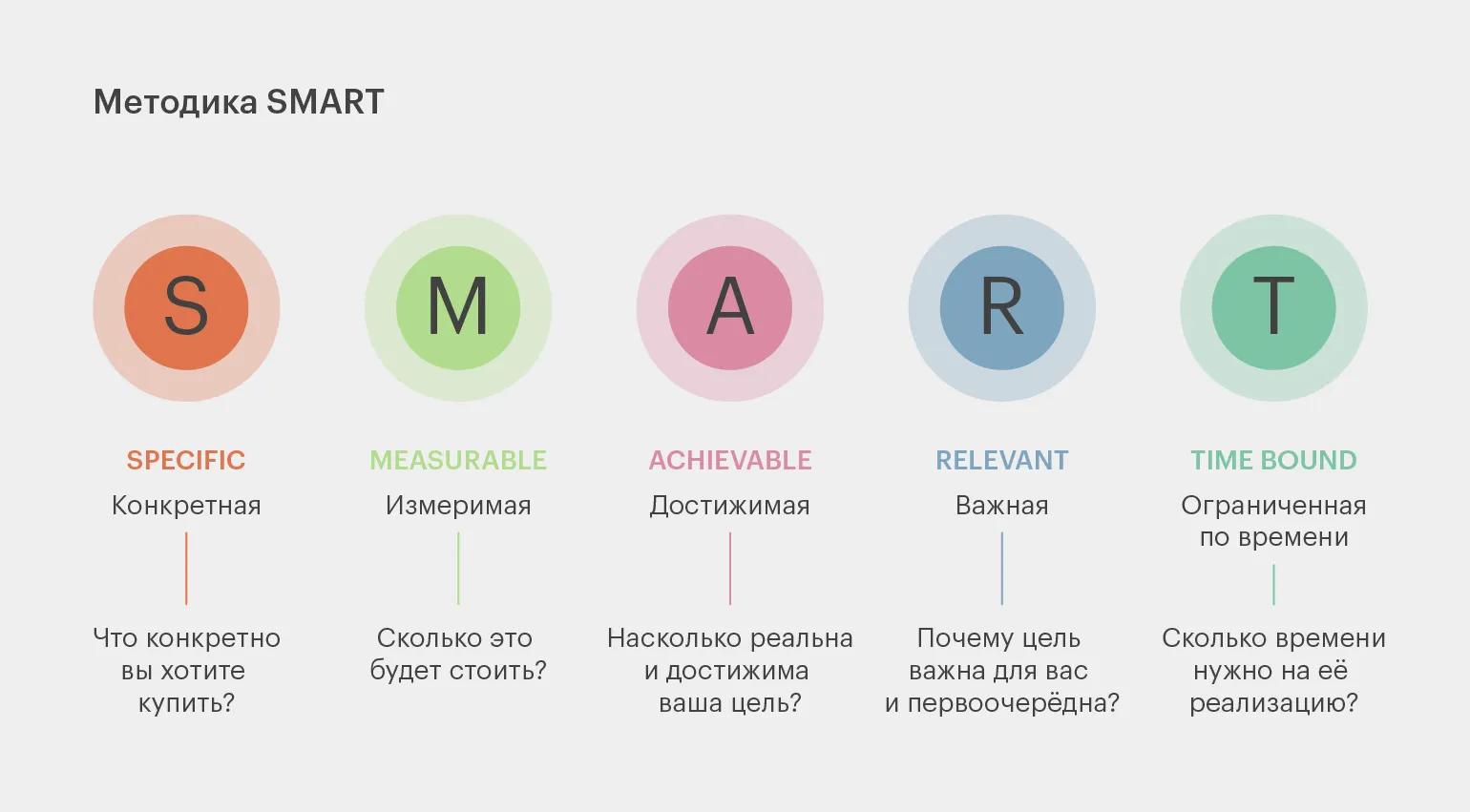
Evaluating your goal can be effectively done using the SMART concept. This technique assumes that the goal should be specific, measurable, achievable, important, and time-bound. Specificity helps you clearly define exactly what you want to achieve. Measurability allows you to track progress and evaluate results. Attainability ensures that the goal is realistic and achievable. Relevance ensures that a goal is connected to overall life priorities and objectives. Time-bound creates a timeframe within which the result must be achieved. Applying SMART principles helps you plan and achieve your goals more effectively.
The right approach: collect funds to purchase a car.
Save up 2 million rubles for a Volkswagen minivan in 1.5 years — This goal is entirely feasible, especially if you're expecting a second child and your current car is becoming too small. To achieve this goal, you'll need to save 111,000 rubles per month. It's important to analyze whether you can allocate this amount from your budget. Consider whether your primary income will be sufficient or whether you will need to seek additional sources of income to ensure the necessary savings.

Revised text:
Also study:
Goal setting and planning are important aspects of achieving success in any area of life. There are many tools that can help you effectively set goals and develop plans to achieve them. Let's look at three useful tools that will make your goal-setting process more structured and productive.
The first tool is the SMART method. This approach suggests that each goal should be specific, measurable, achievable, relevant, and time-bound. Using the SMART method, you can clearly formulate your goals and create an action plan to help you achieve them.
The second tool is daily and weekly planners. These simple yet effective tools help you structure your time and resources. With a planner, you can break tasks down into smaller steps, making them more manageable and less daunting. Regular use of a planner promotes increased productivity and improved workflow organization.
The third tool is progress trackers. These can be apps or simple spreadsheets that help you track your achievements. By recording your successes, you can see how close you are to your goal and also identify areas that require additional attention. This not only increases motivation but also allows you to adjust your actions if necessary.
Using these three tools, you will be able to set goals and plan your actions more effectively, which will lead to the successful achievement of your intended results.
Expense Analysis
We recommend carefully tracking all your expenses for a month, including even the most insignificant ones. Record them in a spreadsheet or use a specialized financial tracking app. Divide expenses into main categories, such as food, transportation, medications, pet care, fuel, beauty services, and entertainment. This approach will help you better understand your spending structure and identify areas where you can cut costs.
Highlight expense categories that cause you doubt. For example, if you feel like you spend too much on takeout coffee, record all coffee purchases in a separate budget line. This will help you more accurately assess your expenses and identify opportunities for savings. By analyzing your expenses, you can better manage your finances and make informed decisions.
Once you have accumulated sufficient data, analyze each expense category. Assess whether your current spending is satisfactory. If not, consider possible measures to optimize expenses and improve your financial situation.
Expense Optimization
There are many options that can be considered depending on the specific situation. For example, you can consider different approaches to solving a problem, including alternative methods and strategies. It is also important to consider the needs and preferences of the target audience, which can significantly influence the choice of the optimal option. Weighing the advantages and disadvantages of each of the proposed solutions will help you make an informed choice. It is also important to keep in mind current trends and innovations in this area to stay one step ahead of the competition.
- What you can give up. For example, food delivery. If you're not ready to give up restaurant meals yet, try switching to takeout—restaurants usually offer discounts for pickup. Consider your psychological state, too. If you really enjoy taking out coffee, don't give it up; save this category for later optimization waves. A detailed analysis will also help identify unnoticed expenses, such as subscriptions to services you don't use but are paying for because you once forgot to turn off auto-renewal.
- How you can save. Habit often plays a cruel joke on us. For example, you're used to going to the same store and have no idea how much your grocery basket costs elsewhere. Check prices elsewhere. Perhaps it's cheaper to buy cosmetics and pet supplies on a marketplace than at a local store. And buy meat and fish at hypermarkets that often have promotions.
- Analyze your shopping behavior. "Red" price tags in stores are a good thing, but only as long as they don't manipulate you. It's a great idea to buy a couple of kilos of meat on sale. It's not so great to buy another pair of sneakers just because they're on sale. Get into the habit of giving yourself a few minutes before each purchase to think about whether you really need it or whether you've fallen for marketing gimmicks.
Income Analysis
If you have multiple sources of income, it's important to create a spreadsheet to track them. This spreadsheet should not only record the amounts earned for various types of work but also indicate the number of hours spent on each. This approach will help you analyze which source of income is most profitable and which one to focus on if you need to save money quickly. Tracking your time and income will optimize your efforts and make financial planning more effective.
Use cashback cards to maximize your financial opportunities. They allow you to earn a percentage back on your spending, making every purchase more profitable. Also, don't forget about tax deductions, which can help reduce your tax burden and reclaim part of your taxes. Government benefits can significantly improve your financial situation by providing access to various subsidies and support programs. Optimize your spending and use all available tools to improve your financial efficiency.
Be mindful of cashback. This marketing tool can encourage you to spend more in order to receive a bigger discount later. It's important to maintain a critical approach to your spending and not let the desire for cashback influence your financial decisions. Moderation and mindful spending will help you avoid unnecessary expenses and stay within your budget.
Optimize Income
Explore new income opportunities and evaluate their financial potential. Consider your professional skills and think about how you can use your knowledge to help others. Perhaps you have a hobby that you've long wanted to turn into a source of income. It's important to find a direction that matches your interests and abilities to ensure a stable income.
An effective way to get rid of unnecessary things and make money is to inventory your items and sell them on platforms like Avito or Yula. This will not only help free up space in your home but also provide an opportunity to earn additional income. Turn old things into money, simplifying your life and making room for the new.
Mistakes that prevent you from saving
Let's look at the most common options.
- Getting scared before you start. What if I don't have enough money for my usual life? What if I feel unhappy? These are questions that make you panic and get upset. Just start and adjust your plan as you go. Gradually, you will come to a strategy that is comfortable for you.
- Breaking down and giving up. Relapse is normal, the main thing is not to blame yourself for making an impulsive purchase and spending your savings. Accept this fact and continue saving.
- Excessive accumulation. Don't hold yourself back. If something brings you happiness, buy it. Consider other ways to save or earn money so that spending on "wants" doesn't seem so overwhelming.
- Financial illiteracy. Buying highly risky assets, transferring money to scammers, or investing in a Ponzi scheme is a guaranteed loss of your savings. Learn to invest and manage risks, study fraudulent schemes to protect yourself.

How to save on a low income?
Saving money is available at any income level. The key to this process is desire and discipline. Even with small incomes, you can gradually build a savings reserve. Regularly saving, even small amounts, will help build sustainable financial reserves that will ensure financial security and stability in the future. Developing a savings habit is the key to successful accumulation. It's believed that when income is low, most of your money goes toward rent and basic groceries. Start with a small amount, such as 100-200 rubles, and create a transparent piggy bank for coins and bills. This will help you develop a savings habit and learn to live on a more modest budget. Once the habit is established and you've mastered budget optimization, try increasing the amount you save. This approach will not only allow you to save money but also improve your financial literacy, which will help you make more informed financial decisions in the future.
How to save on an average income?
The average income in Russia has no clearly defined boundaries and ranges from 30,000 to 100,000 rubles per month, depending on various official sources. To determine your place in this category, it is worth analyzing your lifestyle and financial habits. Pay attention to your expenses, standard of living, and the goals you set for yourself. This will help you better understand whether you belong to the middle-income group.
People with an average income no longer spend all their money exclusively on food. They have free money that they can spend on entertainment, working out at fitness clubs, shopping, and beauty treatments. However, they often lack the funds for major purchases, such as cars or household appliances. While average incomes allow for a better quality of life, financial constraints still impact the ability to make significant purchases. The middle class should be aware that as income increases, so do expenses. The key is to prevent a complete shift to consumption. Effective financial management will help maintain stability and ensure financial security.
Learn to manage your finances using your current income. Try spending a month living on your previous income and saving the rest. This doesn't mean giving up what's available to you, but rather encouraging smarter spending. Focus on spending less than you earn. Start by setting aside one or two thousand rubles, gradually increasing this amount. This approach will help you build a financial cushion and teach you to control your spending.
How to save on a high income?
A high income means being able to buy groceries from premium stores, regularly visit expensive restaurants, and take business-class taxis. It also includes working with a personal trainer at a fitness studio instead of group training. This level of income provides access to high-quality services and allows you to enjoy comfort in everyday life.
If your income is high, it's important to assess your needs and develop intrinsic value to avoid falling victim to luxury marketing. This doesn't mean completely giving up designer clothing or cars, but it does signal a need for each purchase and whether the price is truly justified. Identify the brands you value most and find difficult to give up. A mindful approach to consumption will help maintain financial stability and avoid unnecessary spending.
With a high income, it's important to consider financial instruments such as investing. This may include not only stock market transactions but also real estate purchases or investments in existing businesses. Consider both your personal financial goals and global trends, because money should work for you and bring benefits. Creating a personal financial strategy will become the foundation for achieving your goals and ensure financial stability in the future.

Be sure to check out the additional materials:
Deferred life syndrome is a psychological condition in which a person puts off important matters and dreams indefinitely, believing that in the future he will have more time and opportunities. This can lead to chronic dissatisfaction and missed opportunities.
To overcome procrastination, it's important to understand your true desires and priorities. Start with small steps: set specific goals and break them down into achievable tasks. Create an action plan and stick to it, avoiding procrastination.
It's also helpful to analyze the fears and doubts that prevent you from taking action. Understanding the reasons for your procrastination will help you overcome them. Don't forget the importance of social support – connecting with friends and loved ones can inspire you to change.
Remember, life happens here and now, and it's important to seize every opportunity to achieve your goals. You can overcome procrastination by being mindful of your desires and actions.
Where to store your savings?
Here are some recommendations:
To maximize the effectiveness of your content, it is important to optimize it for search engines. Start by carefully selecting keywords that match your topic and the interests of your target audience. Include keywords in headings, subheadings, and body text to improve search engine visibility.
Structure your text so that it is easy to digest. Use short paragraphs and clear wording to keep the reader's attention. Make sure your content answers questions and solves user problems, which will help increase their time on the site.
Don't forget about internal and external linking. Including links to other pages on your site and authoritative external resources helps improve SEO and expands the context of your content.
It's also important to update your content regularly, adding new information and updating outdated data. This shows search engines that your site is alive and useful to users.
Optimize images with appropriate alt attributes and titles to improve the indexing of your content.
Finally, ensure your site is mobile-friendly. More and more users access the internet from mobile devices, and the importance of a convenient mobile viewing experience cannot be overstated.
By following these recommendations, you can significantly improve the SEO of your content and attract more targeted visitors to your site.
- Keep small amounts of cash—up to 50,000 rubles. Cash insures against risks when money is urgently needed here and now, and provides psychological comfort. It's best to keep long-term savings in a bank where at least some interest will accrue. Keep a small amount on your card and the rest in a savings account. This will help protect you from fraud. If you lose your card, scammers won't be able to withdraw money from your savings account. Also, having funds that aren't reflected on your main card will protect you from impulse purchases. Create both a deposit account and a savings account. Place 80% of your savings in a deposit account and 20% in a savings account. In a deposit account, your money is frozen for a certain period. If you withdraw it early, you'll lose the interest accrued. A savings account has a lower interest rate, but is more flexible. It's best used for small household expenses now, while a deposit account is for saving for the future. Create a minimum financial portfolio. This is especially important for maintaining a financial safety net and long-term savings. You can invest in stable securities, such as bonds, and in foreign currency. Regarding currency, you can choose different strategies: conservative (100% of savings in rubles) or balanced (40% in rubles, 30% in dollars and euros, 30% in alternative currencies such as yuan, rupees, or Hong Kong dollars). If you already have dollars and euros, don't sell them now.
- Try investing. We recommend that beginners do this with an investment advisor and avoid risky options (such as stocks). A great option is to open an individual investment account, buy bonds, and receive coupon income and a portion of the invested money as tax deductions.
Experienced investors can consider a variety of asset classes, including real estate, gold, and cryptocurrencies. The choice of a specific asset depends on your financial strategy and risk tolerance. Real estate investments provide stable income and protection from inflation, gold serves as a safe haven during volatile times, and cryptocurrencies offer high returns but carry significant risks. Proper portfolio diversification, tailored to individual goals and risks, will help achieve successful financial results.
- Is it worth combining two jobs? Yes, if it's a slash career.
- Your Money or Your Life: What Criteria to Use to Choose a Profession?
- 7 Books on Careers and Finding Your Calling.