Contents:

Learn: The Game Designer Profession from Scratch to PRO
Learn MoreSound and music play a key role in interactive cinema, creating deep immersion in the plot. To achieve maximum immersion, studios develop specialized sound design systems. At GDC 2023, Barney Pratt, Senior Sound Designer at Supermassive Games, presented a talk about creating realistic and atmospheric sound design for the first season of The Dark Pictures Anthology. In his presentation, he detailed the sound systems and musical elements his team developed, clearly illustrating their impact on the game's perception.
Skillbox Media's Gamedev editorial team presents the sound designer's key insights. In the gaming industry, sound plays a vital role in creating atmosphere and enhancing gameplay. A professional sound designer is responsible for the development and implementation of audiovisual solutions that help players immerse themselves in the game world. High-quality sound can evoke emotion, emphasize character actions, and create a unique atmosphere. It is important to remember that competent sound design requires not only technical skills but also a creative approach. Thus, sound design is an integral part of game design, contributing to the creation of memorable and engaging game projects.
This article contains spoilers for the first season of The Dark Pictures Anthology. Key plot points and important twists that can impact how you experience the game are discussed. The Dark Pictures Anthology is a series of interactive horror games in which players make decisions that influence the plot and the characters' fates. The first season includes several gripping stories, each exploring different aspects of fear and human psychology. Players will face moral dilemmas and dangers that make each game unique. Let's look at the key events and characters that left an unforgettable mark on the first season.
List of terms mentioned in the report
5.1 is the most popular surround sound system that provides an immersive sound experience. It includes five full-frequency channels and one channel for low-frequency effects. This configuration creates an immersive audio experience ideal for watching movies and listening to music. The 5.1 system delivers high sound quality and a realistic audio experience, making it the preferred choice for home theater systems and audiophiles.
The Aux Send in Wwise is an additional output signal that allows objects to send audio at individually adjustable volumes to a separate group of sounds. This functionality is widely used to add special effects, such as reverb or echo, to various audio sources. Using Aux Sends helps create a richer and more layered soundscape, enhancing the overall experience of audio tracks. With flexible volume control, Aux Sends are an essential tool for sound designers and composers in the creation of interactive audio.
HDR in audio is a mixing technique that achieves a wide and varied frequency range, close to natural sound. Thanks to this technology, sound becomes richer and more spacious, providing listeners with a unique experience of perceiving music and sound effects. HDR allows for fine-tuning of audio parameters, creating the possibility of a deeper immersion in the audio space.
RTPCs, which stand for Real-Time Parameter Controls, are real-time parameter settings used in the Wwise audio engine. These settings allow you to control audio fragments and their behavior depending on various game conditions. Integrating RTPC into Unreal Engine's standard sound sequences enables deeper adaptation of audio to gameplay, enhancing player immersion and creating dynamic audio. Using RTPC in Unreal Engine projects allows developers to create more interactive and adaptive audio, which positively impacts the overall gameplay experience. In Wwise spatial audio, azimuth is the angle between the listener and the game object, projected onto the horizontal plane. A value of 0° indicates the sound is coming from directly in front of the listener. A value of -90° means the sound is perceived from the left, and 90° means the sound is perceived from the right. Angles of +/- 180° indicate the sound is playing behind the listener. Understanding azimuth in spatial audio allows for the creation of more realistic soundscapes in games and other media, enhancing immersion and user interaction with the virtual world.
Attenuation is the process of positioning sounds in a virtual environment so that some sounds are perceived by players at a constant volume, while others become quieter and increase in volume as the player approaches. This technique plays a key role in creating a realistic sound environment, allowing players to better navigate space and enhance immersion. Effective attenuation of sound effects helps create a dynamic auditory perception, which enhances the gaming experience and promotes deeper interaction with the virtual world.
Ducking is the process of reducing the volume of one audio track to improve the audibility of another. This method is often used in audio production to create a balance between different sound elements, providing a clearer and more harmonious sound. Ducking can improve the perception of music, speech, or other sound effects, making it an important tool in mixing and mastering audio tracks.
Sound diffraction is the phenomenon by which a sound wave avoids small obstacles whose dimensions are equal to or smaller than the wavelength. This property of sound allows it to propagate beyond obstacles, creating the effect of audibility in areas where sound would seem to be blocked. Diffraction plays an important role in acoustics and helps explain why we can hear sound around corners or from behind walls. Understanding this process is useful not only in scientific research but also in practical applications, such as designing acoustic systems and improving the sound quality of rooms.
A cardioid microphone is a type of directional microphone characterized by a polar pattern resembling a heart shape. This microphone effectively captures sound coming from the front while rejecting noise coming from the sides and rear. Due to their design, cardioid microphones are ideal for recording vocals and instruments in noisy environments, delivering high-quality sound. Cardioid microphones are commonly used in studio recording, live performances, and broadcasting, making them indispensable in the world of audio production.
A hypercardioid microphone is a type of directional microphone that features a narrower pickup pattern than a cardioid microphone. This makes hypercardioid microphones ideal for recording audio in environments where background noise must be minimized and specific sound sources must be emphasized. Due to their design, hypercardioid microphones are able to effectively capture sound directed toward them, making them popular in studio recording, live performances, and broadcasting.
A directional microphone is a special type of microphone that has increased sensitivity to sound coming from one specific direction. These microphones minimize the pickup of noise from other directions, making them ideal for recording voices and sounds in environments where background noise reduction is essential. Directional microphones are widely used in a variety of fields, including sound recording, film, and television, due to their ability to accurately capture sound from a specific source, significantly improving recording quality.
Sound panning is the process of distributing an audio signal across the left, right, and center channels (LCR). Depending on the listener's position, panning emphasizes sounds from one side, creating a spatial effect. This technical solution helps improve the perception of music and sound design, providing a more immersive audio experience.
Reverberation is the gradual decrease in the intensity of a sound signal as it bounces off surfaces in a room. This phenomenon plays an important role in acoustics and influences the perception of sound. Reverberation can create a sense of space and depth in musical recordings and sound effects. Understanding reverberation can improve the sound quality in various audio systems and concert halls.
Sidechain is a method of controlling the parameters of one channel or device using another device or signal. This technique is widely used in audio production to create unique effects and dynamic sound processing. Sidechain allows, for example, the volume of one track to be reduced depending on the signal level of another, which helps achieve a cleaner and more balanced mix. Using sidechain opens up new possibilities for sound engineers and musicians, allowing them to experiment with the dynamics and texture of sound.
Sidechain compression is an audio processing method that reduces the volume of one audio signal while another signal is active. This technique is based on channel hierarchy, allowing certain sounds to become more pronounced depending on the playing context. Sidechain compression is widely used in music production and game design to create dynamic and balanced sound, improving the perception of audio content and its quality.
A listener in the Wwise audio engine is an object that functions as a virtual microphone. Its main task is to distribute incoming sounds among the speakers based on their location in the 3D scene. This creates a realistic sound environment where sounds are perceived based on distance and direction, significantly improving the user's immersion in the gaming environment. Properly setting up a listener in Wwise is key to achieving high-quality audio perception in games and interactive applications.
Sound leakage is a phenomenon where sound waves escape the device and propagate into the surrounding environment. The most common example of sound leakage is when music from headphones becomes audible to people nearby. This problem can occur with both standard and professional headphones, affecting listening quality and creating discomfort for those around you. Reducing sound leakage can increase personal audio privacy and improve the listening experience for music or audio content.
Foley and foley effects in filmmaking are sound effects added to video footage to create a more realistic atmosphere. These sounds include various noises and background effects, such as the rustling of clothes, footsteps, the crunch of branches, and many other sounds familiar to us from everyday life. The use of foley effects can significantly improve the perception of a film, immersing the viewer in the action on screen and enhancing the emotional coloring of scenes. Adding such effects is an important part of the post-production process and helps make a film more vibrant and impactful.
Equalization is the process of changing the loudness of individual frequencies of an audio signal within its frequency spectrum. This allows you to either reduce or boost specific frequencies, which affects the overall sound of music or audio. Equalization is widely used in music, recording, and live performances to achieve a desired sound and improve audio quality. Proper equalization helps to highlight certain instruments, vocals, or create a harmonious sound as a whole.
Briefly about the speaker and the content of the report

In the early 2000s, Barney Pratt began his career as an assistant sound designer in the film industry, where he made significant contributions to iconic films such as Troy, Batman Begins, and Harry Potter and the Goblet of Fire. His experience in film prepared him for his new role, and he soon became a sound designer at EA Games. For almost three years, he was responsible for the audio of the Harry Potter games, which allowed him to express his creative abilities and make a unique contribution to the video game industry.
Barney has been with Supermassive Games for almost 15 years, since the studio's founding in 2008. During this time, he has developed numerous sound systems for various company projects, thanks to the support of an ever-growing team. The sound department currently consists of 18 sound designers and a production manager who coordinates the studio's collaboration with renowned composer Jason Graves. This team's experience and professionalism allow Supermassive Games to create high-quality audiovisual projects that win the acclaim of players worldwide.
The Dark Pictures Anthology is an interactive horror series offering multiple plot branches and gripping stories set in various historical periods. Each game includes a large number of cutscenes and episodes, where players can explore a variety of locations. The game is available in both single-player and multiplayer modes, supporting 2 to 5 players, and also offers a co-op mode for co-op play with friends.
Eight games are planned, and the first season includes four episodes: Man of Medan, Little Hope, House of Ashes, and The Devil in Me. Using these games, Barney analyzes sound system development methods. In particular, he explores how sound effects and music affect the atmosphere and player interaction with the game world. These aspects are key to creating an immersive gaming experience, which makes the study of sound design especially important for developers.
- systematization of sound effects in a game with branching plots;
- use of procedural foley effects for characters and creatures;
- attenuation;
- interactive mixing: how to balance all sounds when playing in a game;
- analysis of the directional microphone mechanics from Episode IV;
- how to enhance dramatic effect using diegetic music.
Systematization of sound in a game with non-linear narrative
In The Dark Pictures Anthology, the player actively influences the development of the plot. The illustrations below illustrate how the characters' various choices and actions create branches in the game's narrative. This mechanic adds interactivity and allows each player to have a unique experience, creating their own stories.

Зелёные ноды представляют собой кат-сцены, разработанные с использованием Sequencer в Unreal Engine. Красным обозначены участки с интерактивными эпизодами, где игрок принимает решения, влияющие на развитие сюжета. Это может включать выбор диалогов и ключевых решений, а также прохождение сцен с элементами QTE. Пустые сегменты, выделенные жёлтым цветом, содержат стандартный геймплей от третьего лица, включающий элементы исследования. Такой подход позволяет создавать более увлекательный и разнообразный игровой процесс, обеспечивая игрокам возможность влиять на ход событий и погружаться в сюжет.
В нижней части представлена информация о звуковых эффектах, которые используются в ноде с кат-сценой. Все аудиофрагменты организованы в линейную секвенцию. В состав этой секвенции входят:
- диалоги;
- SFX, они же звуковые эффекты;
- дополнительные линейные фоли-эффекты для персонажей, которые записывались как при стандартном производстве кинокартин. По сути это минимальные дополнения, которые не были включены в процедурные звуковые системы, — например, звуки перемещения стула, трения верёвки о стену, удержания двери телом, шуршание ткани при ползании и другие редкие аудиофрагменты.
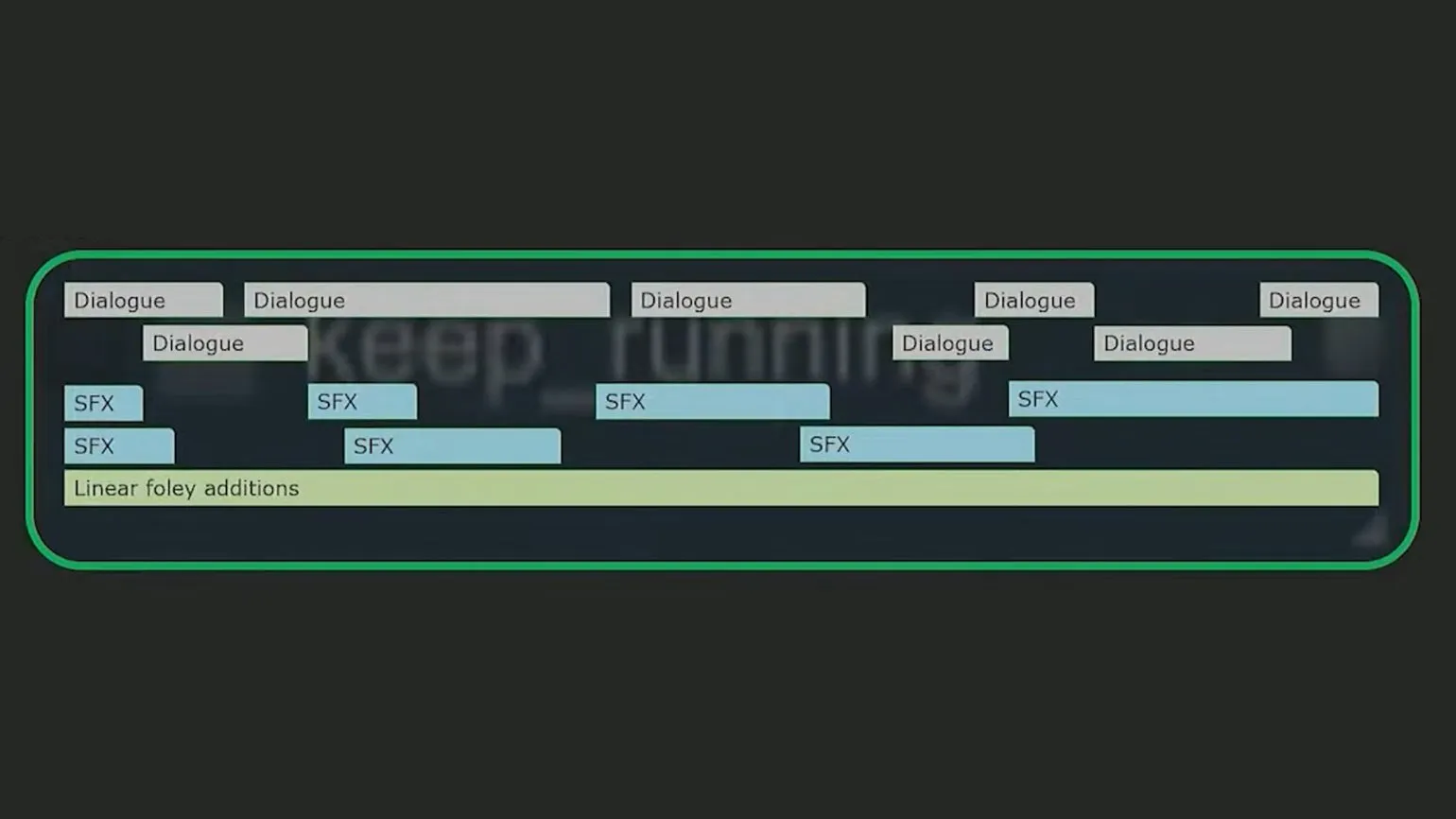
В линейных секвенциях также используются RTPC в виде кривых. В предыдущей ноде они отсутствуют, поскольку подключение RTPC осуществляется на следующем этапе, вместе с музыкальными элементами.
Other parts of the game, featuring interactive sequences and exploration elements, make extensive use of system audio. This method ensures smooth gameplay and deep player immersion, which is critical to the overall atmosphere of the game. System sounds include:
- character breathing and reactions to various AI challenges;
- atmospheres (soundscape) - groups of sounds and their arrangement;
- musical and sound design.
Procedural foley effects play a key role in the sound design and include all sounds associated with characters, such as the rustling of clothing, footsteps, and other sound elements. These effects significantly enhance immersion in the gameplay and create a more realistic atmosphere. Detailed information about foley effects will be provided below.
All sound systems are regularly updated, and the studio invests significant resources in their development. These systems help balance character sounds in both cutscenes and gameplay. They also play a key role in the finalization of a project: game development takes about a year, and if adjustments to the sound design are required, integrating them without such systems becomes significantly more difficult. Using modern sound technologies guarantees high-quality sound and improves the overall immersion of the game.
Procedural Foley Effects
In cinematic games, creating a compelling character is key. Supermassive Games uses procedural foley effects to achieve this. The term "foley" covers a wide range of sound effects, but in the context of the studio's sound designers, it refers to any aural interactions between a character and the environment. This significantly increases the player's immersion in the gameplay and makes each scene more realistic. The use of foley effects helps create a unique atmosphere and emphasizes the characters' emotions, which in turn enhances the overall perception of the game.

The procedural approach has several significant advantages. First, it ensures clarity and structure of code, making it easier to understand and maintain. Second, this approach promotes code reuse, as functions and procedures can be used in different parts of the program. This reduces development time and increases efficiency. Third, the procedural approach simplifies debugging, as errors can be isolated to individual procedures, making them easier to find and fix. Furthermore, using a procedural approach promotes better memory and resource management, which is especially important in the development of complex applications. Thus, the procedural approach is a reliable tool for creating high-quality software.
- coverage of most foley effects;
- the end result is easier to finalize during a year-long development;
- saving time and budget;
- stressful situations are generally minimized;
- the system is also suitable for other projects, so it pays off all the costs;
- ensures integrity between fragments of cutscenes and gameplay with exploration, this particularly applies to foley effects of weapons, which will be discussed below.
The game House of Ashes actively uses a unique game system that allows for deeper immersion in the story. The events unfold in Iraq in May 2003, where American special forces are searching for weapons of mass destruction. Instead of the expected arsenal, the soldiers encounter an ancient Sumerian temple lost underground, inhabited by extraterrestrial beings. This unexpected turn of events adds tension and intrigue, creating a unique experience of interacting with the game world.

Read also:
Secrets of the House of Ashes game design: analysis of narrative and nonlinearity Featuring expert input. This study delves into a unique approach to storytelling and game mechanics that enable players to make meaningful decisions. Experts share their insights on how nonlinear narrative structures influence storytelling and character interactions. A key aspect is how player choices shape storylines and create varied endings, making each playthrough unique. We examine how the designers used elements of horror and drama to create a tense atmosphere, as well as how the visual style and sound enhance immersion in the game world. By analyzing House of Ashes, we understand how design and narrative elements are skillfully intertwined, making this game a landmark in the interactive storytelling genre.
The procedural foley effects in this game are classified into several categories. In this article, we will examine each of them in detail to understand how they impact gameplay and the overall perception of the world. These effects add realism and depth, enhancing player interaction with the environment. Learning about the different groups of foley effects will help you better understand their role in creating a fun and immersive gaming experience.
Steps are sequential actions that help you achieve a specific goal. It is important to organize each step properly to ensure the efficiency of the process. Each step should be clear and understandable. This will avoid confusion and increase productivity. Defining the sequence of steps helps you better control the execution of tasks and measure progress. Effective planning of steps contributes to the successful completion of a project and the achievement of the desired result.
- walking and running, the sound of which is the playback of small files and depends on the speed of the character;
- slow walking, requiring additional fine-tuning;
- friction of soles on the surface;
- landing;
- movement of creature limbs.
The sounds of footsteps in House of Ashes vary depending on the type of surface the character is moving on. The game features 2,630 different materials, which significantly enriches the gameplay and adds realism. Each material creates a unique sound, allowing players to more deeply immerse themselves in the game's atmosphere.
Fabric rustling produces sound effects similar to footsteps, but in this case, the sounds are created through the interaction of various textile materials. The intensity of these sounds depends on the degree of bending of joints, such as knees and elbows, in the model's rig. For example, the more a character bends their elbow while moving, the more noticeable the sound of clothing friction will be. Properly setting these effects allows you to add realism and depth to a character's movement, making them more lifelike and convincing in a game or animation context.
Equipment is an important element that includes the sounds created by various character accessories, such as holsters, vests, jewelry, and other details. These sounds enrich the overall sonic atmosphere, adding variety and sophistication. Properly selected equipment not only complements the image but also enhances immersion in the gameplay, making it more realistic and engaging.
Firearms in House of Ashes are presented with realistic sound effects, including the noise of the magazine, sling swivels, and bolt. This set contains three types of samples that vary in speed: low, medium, and high. Each sample emphasizes detail, creating an immersive atmosphere in the game. These sound elements enhance the realism of the gameplay and make it more engaging for users.
Patches represent the sounds produced by touching the outer, back, and side surfaces of the hands. These audio foley effects are still being improved, but the current version of the system already demonstrates the ability to create realistic sound effects. Improving these effects is important for creating a deeper and more immersive audiovisual environment.
Creature wings and the foley effects of their flapping are the result of the adaptation of various systems. These unique mechanisms provide not only lift but also maneuverability in flight, which is especially important for survival in the wild. Studying foley effects allows us to better understand the aerodynamics and evolution of wings in various species, which has implications for both biology and engineering.
Procedural foley effects for characters are created using sound emitters, which are configured in the game engine. In this context, emitters are devices attached to the character mesh, which effectively reproduce sound effects corresponding to the character's actions and movements. Proper placement and configuration of these emitters play a key role in creating an immersive sound atmosphere, which significantly improves the overall perception of the gameplay.

Emitters provide real-time audio playback and are configured using Wwise's RTPC parameters. This allows for the creation of realistically simulated sounds that change depending on the character's movement in the game world. Using RTPC to control sound effects significantly improves the player's immersion in the game's atmosphere.
In House of Ashes, the sound designers focused on spatial audio that effectively emphasizes the scale of ancient caves, narrow tunnels, and unique in-game locations. Implementing such a sound system is straightforward, as it is supported by Wwise's core features. However, given the specifics of the gameplay, the specialists needed to optimize the load on the CPU. For example, eight emitters generate thousands of API calls, and when multiple characters appear in a scene, including vampires with twelve emitters, the performance requirements increase significantly. Numerous RTPC settings and sound diffraction parameters can significantly impact overall game performance.
The team developed a clipping system that displays only those events and emitters within the listener's range. This optimizes performance and improves the efficiency of real-time data processing. The system provides a more targeted approach to user interaction, allowing them to focus on the most relevant information.

Pause Calling all emitters outside a defined area plays a key role in creating combat scenes involving various characters. Barney emphasizes that the clipping system helped optimize spatial audio, taking into account the specifics of each platform. For example, the number of emitters was reduced for PlayStation 4 and Xbox One, while their number was expanded for next-generation consoles. This allows for higher-quality audio and an improved overall gaming experience.
During the development of procedural foley effects, the sound designers considered that animation notifications were unsuitable for a short development cycle of only one year, since individual animations could change right up until the final release. Therefore, a flexible system capable of handling both movement animations and mocaps was necessary. This was achieved by linking RTPC emitter settings to character movements. New animations for landings and moving along walls were added to the system. The team also implemented an additional audio layer for interactions with various materials, such as ruins, plaster floors, and puddles. The result is a richer and more realistic audio experience, which can be seen in the character footsteps video, which takes these settings into account.
This section provides information about the foley effects associated with various types of weapons as the character moves. It also discusses the sounds of objects that occur when interacting with them, and procedural foley effects associated with hand clapping. These elements play a key role in creating a realistic gaming experience and immersing the player in the virtual world.
In the following video, you can hear procedural sounds of the characters, including the rustling of fabric and equipment. These sounds, although less noticeable, organically complement the overall sound design. The sounds of footsteps and flapping wings of creatures are implemented in a similar way.
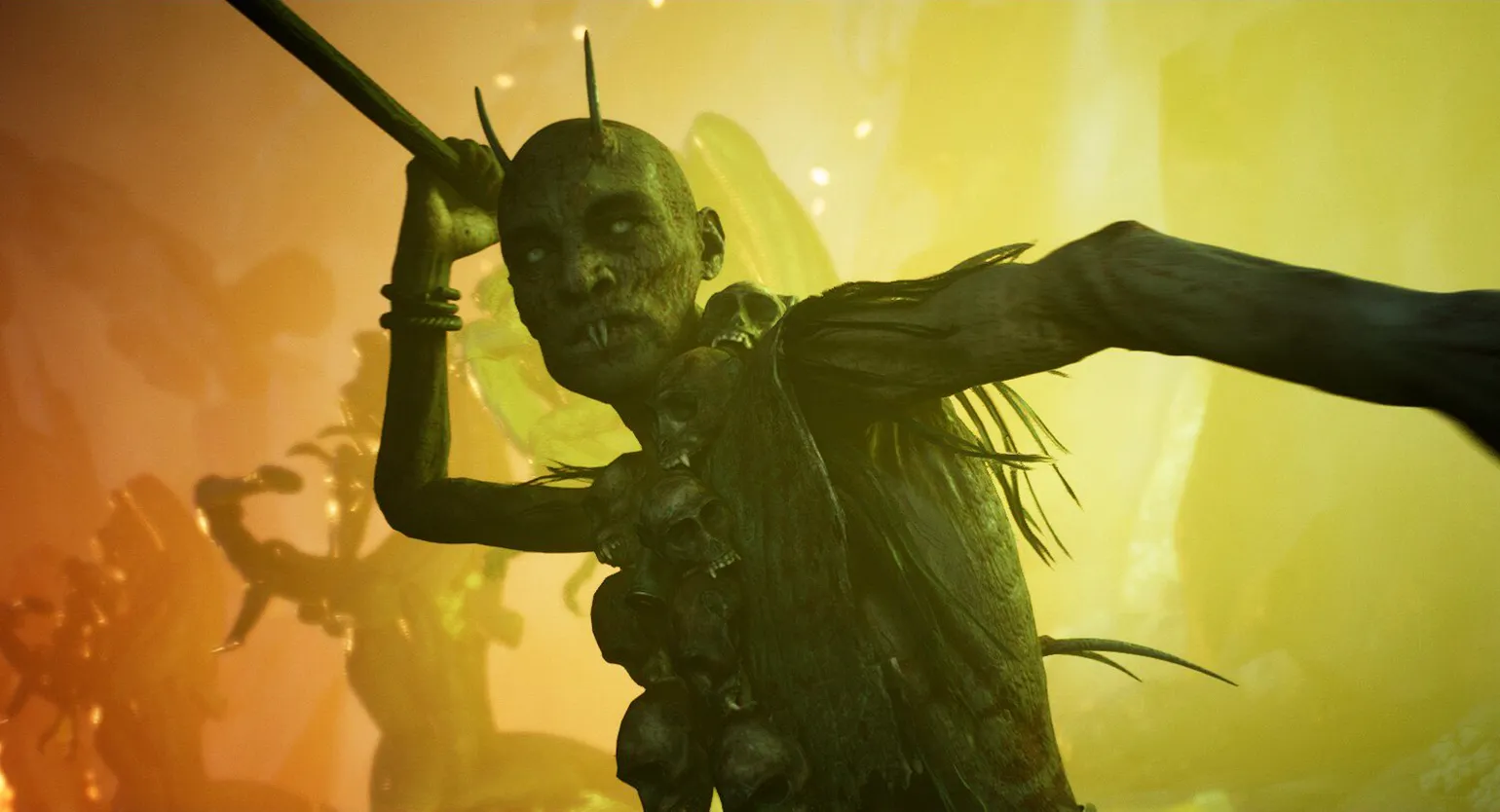
House of Ashes places significant emphasis on vampires from outer space. Using standard soundtracks to voice them proved impractical, as the game features over a thousand unique scenes featuring these creatures. As a result, the developers created their own foley effects system capable of providing a wide range of actions. In addition, the vampires' movements were realized not only through keyframe animation, but also using motion capture technology (mocap). This allowed for a high level of realism and expressiveness in the characters in the game.
An example of a cyclical vampire walk animation demonstrates the unique movement of this mythical creature. Although in this case the vampire moves on all fours, in some scenes it uses only its hind limbs, which are designed like a horse, supplemented with an additional joint for greater mobility. In addition, vampires have wings, which lends a special grace and drama to their movement. This animation provides a deeper understanding of the physics and character of vampires, which is important for creating realistic images in various media formats.
The anatomical features of vampires did not allow for a full adaptation of the emitter system used for human characters. Instead, the team focused on adapting procedural footstep effects and fabric rustling for the new model. Designing the wings required developing a procedural system from scratch, but technologies similar to those used for human characters were used. The vampires' screams and hisses were hand-crafted using time-tested techniques. The sound designers did a tremendous job, paying close attention to every detail to achieve the most realistic sound for these creatures. We recommend checking out the final result.
We present to you another example of a video sequence featuring vampires, which includes a full sound and music accompaniment. This video immerses viewers in an atmosphere of mystery and horror inherent in vampire themes. Music and sound effects enhance the perception, creating a unique experience for the audience.
Interactive Mixing
Sound engineers perform several key steps in the process of creating high-quality sound. The first step is recording the sound, where the correct equipment setup and the choice of suitable microphones are important. Then comes the editing stage, during which sound engineers process the recorded tracks, removing unnecessary noise and adding effects. After this, mixing occurs, during which all the sound elements are combined into a single whole to achieve harmonious sound. The final stage is mastering, during which the final version of the track is prepared for release and ensures optimal sound on various audio platforms. These steps enable sound designers to create professional audio recordings that meet high quality standards.
- Mixing sound effects throughout the process using shared assets for characters in cutscenes and exploration gameplay segments;
- Panning with a 50% center offset;
- Working with attenuations to create emphasis;
- Moving the listener position, detached from the player/camera position;
- Using sidechain instead of HDR.
This set of features ensures that all sound systems interact harmoniously, creating an immersive effect.
During the dialogue panning stage, Barney's team faced a significant challenge. Due to the dynamic camera angles, the position constantly changed during conversations, resulting in unstable panning from one side to the other. There were two ways to solve this problem.
- Play all dialogue through the center speaker only, as in previous-generation films. However, this would make the performance sound lifeless, as it lacks the directionality typical of games.
- 5.1 surround panning would provide excellent sound directionality, but would result in severe clipping of some effects, which would also break the player's immersion.
The sound designers reached a compromise between the two approaches. They adapted the panning for all dialogue and foley effects, halving its intensity. This solution improved the sound and created a more harmonious sonic atmosphere in the work.
As a result, a 50% center offset system was developed. In practice, this meant that if a character made a sound outside the center zone, the position of the sound source remained fixed relative to the listener, but the sound was played back taking into account the new panning offset. The center speaker changed its position, but had no direct connection to a specific sound. The examples below demonstrate that the sound panning value is proportional to the in-game emitter position, which helps create a more realistic sound atmosphere.


When the object emitting sounds is in the player's field of view, the main part Audio signals are transmitted through the center speaker. Sound panning is dependent on the object's position relative to the left or right. This approach not only eliminates abrupt sound changes when the camera angle changes, but also increases player engagement, improving overall immersion. This would be impossible if dialogue were played exclusively through the center speaker.
The closer the sound emitters are to the listener, the more details and nuances of sound perception can be discerned. The infographic below shows the gradation of volume attenuation for various sounds depending on the distance to the listener, who is located near the camera. This information is important for understanding the acoustic features and optimizing sound design in various environments.

The diagram demonstrates that When a character is at a significant distance from the listener, the sounds of rustling fabric, equipment, and weapons are not perceived. However, foley effects for footsteps remain audible, helping to maintain a sense of presence and connection with the environment. Character lines are always audible, regardless of distance, as they play a key role in the development of the plot. This creates a deeper immersion in the game and strengthens the emotional connection between the player and the characters.
When the listener is close to the character, they will be able to hear the sounds of rustling fabric and accessories, creating a sense of direct contact. This enhances immersion and makes interactions more realistic. Sound design plays a key role in creating a sense of intimacy and involvement in what is happening.

When detaching the listener By varying the camera's position and moving it to any point in the game world, the effect is similar to well-known film techniques, where the viewer becomes an invisible observer of the characters' conversations. This technique is often used in scenes where characters communicate in enclosed spaces, such as cafes or cars, while the camera captures them from the outside. This technique creates an atmosphere of intrigue and allows the viewer to feel like they are part of the action, which enhances immersion in the plot and emotional connection with the characters.

This approach effectively solves problems associated with occlusion, which occurs when sound cannot pass through an obstacle. In such cases, the spatial sound wave does not reach the camera's position. This technique improves sound quality and creates a more realistic soundscape, which is especially important for audiovisual projects and virtual reality.
To create an uneasy situation for the player, sounds can be used not only from the detached listener but also from environmental objects. This technique is especially effective in scenes where a character, such as a killer, eavesdrops on a conversation while hiding behind a bush. In such situations, sound design enhances the atmosphere and tension, allowing the player to become more immersed in the gameplay. Schematically, this can be represented as follows.


It should be noted that these settings are intended exclusively for creating foley effects. Dialogue is adjusted separately, and, in any case, dialogue will always prevail over other muffled sounds. This ensures that dialogue is clearly audible, which is an important aspect in audiovisual content. Properly setting up foley effects and dialogue helps create a more realistic sound environment and improves the audience's perception of the scene.
The standard audio track hierarchy used by sound engineers includes priority fragments located at the top. Specialists use various sidechain combinations, such as ducking, frequency equalization, which is especially important for dialogue, as well as sidechain compression performed with smooth transitions. These techniques help create balanced and high-quality sound in audio productions, ensuring clarity and distinctness of sound.

During the audio mixing process, low-priority sounds can dominate, as more significant audio cues are sometimes interrupted. This allows the team to manipulate the soundscape, adapting it to the desired cinematic effects. This approach helps create a unique atmosphere in the film, effectively focusing the viewer's attention on key moments.
In Little Hope, the sound designers implemented a unique effect that transforms the diegetic sound as characters move through fog. This effect could be adjusted using various plugins and RTPC settings. For this episode, the team also adjusted the pitch of all atmospheric elements to effectively convey the protagonist's psychological state. This allowed players to experience frightening moments with heightened intensity, creating a reality-bending effect.

An example of an action scene on a boat from The Devil in Me demonstrates a high level of dynamism and tension. This sequence features a lot of action that keeps the player engaged and focused on the action. The scene effectively creates an atmosphere of tension, which makes the gameplay more exciting and engaging.

In the structure of sound Each audio signal performs a unique role within the tracks. For example, a boat engine, labeled "Boat engine loops," runs continuously but occasionally revs up. This is accomplished using a separate sound effect, labeled "Engine revs" in the diagram. These audio cues fill in the gaps between the main tracks of key sound effects, creating a more complete and realistic sound environment.

The scene takes place on a lake, where sound effects of water washing over the hull of a boat are heard. As the story unfolds, characters jump out of the boat, creating impressive splashes and splashes. These sound elements enhance the atmosphere and make the scene more realistic, immersing the audience in the action.

In intense action scenes, sound design plays a key role. Combat sounds, such as punches, kicks, and melee weapons, must be clear and expressive. Each audio fragment must blend harmoniously with the others, creating a dynamic and immersive atmosphere, even with multiple audio tracks. Effective sound reinforces the action and makes the scene more realistic and engaging for the audience.

The sound engineers have implemented several additional sound submixes, a detailed description of which can be found here. Please see the gallery below. This will allow you to better understand the features of the sound design and evaluate the quality of the specialists' work.


This scene is part of an interactive movie, which means that not all characters may be represented in it. Even if the heroes manage to overcome the challenges and reach the ship, their fates can be both tragic and successful in this scene. Throughout the game, players can collect various items that will significantly affect the fates of the characters. The scene also contains the aforementioned attenuation and slow-mo effects, which change the soundscape and the tempo of perception. The sound engineers did a significant job of interactive mixing, taking all of these aspects into account. Below is a fragment of one of the possible versions of this scene in the game.
Directional Microphone
One of the key features of The Devil in Me is the directional microphone. This feature allows players to interact more effectively with the environment and discover new aspects of the gameplay. The directional microphone enhances sound effects, allowing you to better capture important sounds and whispers that can affect the development of the plot. This element not only increases the level of immersion in the game's atmosphere but also adds a strategic aspect, as players must pay attention to sounds coming from different directions. This makes the gaming experience more engaging and interactive, drawing attention to both the details of the plot and the mechanics of interaction with the world.
- its presence is determined by the narrative and one of the key gameplay mechanics, as according to the plot, this device is used by the sound designer Erin;
- the microphone is controlled by the player;
- it is tied to the third-person view;
- it works on the principle of a shotgun microphone.
To implement this key feature, the team had to create an in-game simulation of the device and determine the required microphone pattern—cardioid or hypercardioid. This was important to enhance the feeling of fear and claustrophobia in players. The sound designers simulated the microphone's off-axis attenuation, adjusting the virtual device so that it ignored sounds outside its directivity zone. The result is a realistic sound leakage and reverberation effect, significantly enhancing immersion in the game's atmosphere.
During gameplay, Erin can put on and take off her headphones at any time, allowing all RTPC settings to be saved in real time. This ensures a seamless audio experience. Additionally, the microphone handle is equipped with procedural foley effects similar to those used for weapons. This creates a realistic simulation of unwanted background sounds that may occur during recording but are present in real life.
In Wwise, the directional microphone settings are presented in a user-friendly interface, allowing users to easily adjust recording parameters. These settings include microphone type selection, volume adjustment, and the ability to apply filters to improve audio quality. Thanks to the intuitive design, users can quickly tailor the sound to the needs of the project, making Wwise the ideal tool for professional audio production. Properly setting up a directional microphone in Wwise significantly affects the quality of recorded audio, allowing you to achieve the best results in your sound design work.

Barney's team has been working on the azimuth settings mentioned earlier. The microphone diagram shows sharper curves, and an additional Aux Send curve has been added. The sound designers concluded that, in a gameplay context, azimuth should depend on the camera's direction, not the character's, since they can be turned to face the player. The video below demonstrates how the directional microphone mechanics work in practice.
Diegetic Music
Diegetic music includes compositions that fit organically into the context of a game or film, making it audible to the characters. The soundtrack for the first season of The Dark Pictures Anthology was created by composer Jason Graves. The musical pieces in this project emphasize the tempo and plot, and also focus on locations and historical eras. This text provides a brief overview of the musical design of each episode, revealing the features and atmosphere of the works.
- Man of Medan takes place in the South Pacific, and the soundtrack is three-quarters composed of wave-style compositions. However, when the heroes find themselves on a ghost ship, orchestral and piano parts can be heard.
- The events of Little Hope take place in the fictional city of the same name, but the script itself was written based on the events associated with the trials and executions of "witches" in the American city of Salem in 1692. The soundscape was more minimalist, and to create it, the team studied the specifics of musical instruments of the late 17th century.
- The narrative of House of Ashes begins during the times of the ancient Sumerians, and then abruptly shifts to events taking place in Iraq in the early 2000s. And the orchestral parts give way to synthesized compositions with motifs typical of fantasy genres, since the vampire creatures are representatives of an alien race.
- The events of The Devil in Me take place in Chicago in 1892. This episode's soundtrack is inspired by the work of American composer Bernard Herrmann, who created scores for Hitchcock films. The Devil in Me also features excerpts from classical music and operatic arias, accented with aleatoric orchestral techniques to heighten the drama.
Here's a selection of musical compositions from the first season of The Dark Pictures Anthology. Full versions of the soundtracks for each episode are available to listen to on the composer's Spotify page. Discover atmospheric melodies that highlight the tension and emotional depth of each story.
Barney's team developed a system that significantly enhances the drama of diegetic music. Initially, excerpts from classical compositions and operatic arias were played in mono from a gramophone, but were soon given stereo sound. To achieve this effect, the sound engineers used three key RTPC parameters in Wwise. These settings provided a deeper immersion into the musical atmosphere, which contributed to the creation of a unique sonic experience for the listeners.
- mixing mono and stereo files;
- introducing reverb to emphasize certain moments;
- distortion control, if it was necessary to intentionally spoil the composition at critical moments.
All audio fragments, including classical excerpts, were originally recorded in stereo. This created difficulties for the team when transforming the sound of the compositions in interactive episodes. To achieve a high-quality result, the specialists had to make numerous compromises and make significant edits.
This example presents a composition that accompanies the moment of a character's potential death. Diegetic music begins playing behind the door and then moves into the scene, gradually increasing in intensity at different points in the location. This creates a dramatic effect and enhances the emotional load. Ultimately, the musical accompaniment covers the entire scene, emphasizing the tragic ending and enhancing the impact of what is happening.
Results
Over the course of its 14 years, Supermassive Games has established itself as one of the UK's leading gaming companies, winning numerous awards for its achievements in interactive cinema and virtual reality. Among its most notable projects is Until Dawn, which won a BAFTA Award for Best Original Intellectual Property in 2016. The Dark Pictures Anthology: Little Hope also made a mark, winning the 2021 NAVGTR Award for Outstanding Sound Design. Critics praised the innovative directional microphone gameplay in The Devil in Me, with NME calling the new mechanic "killer ASMR." Supermassive Games continues to develop its unique approaches to creating immersive content, confirming its status as an industry leader.
Barney emphasizes that his team's audio developments, including the foley system, set high standards several years ago. Today, many developers use similar methods, and some studios have reached the level of Supermassive Games. This does not mean that Barney's team has achieved perfection, but the systems developed have become an important part of the "cinematic DNA", which allows the company to create AAA-class content every year.

Creating Horror Content Creating a film without jump scares is an interesting and challenging process. Audio director Vasily Kashnikov shares helpful tips for achieving the necessary atmosphere of fear and tension.
The first step is working with sound design. Ambient sounds, such as creaking floorboards, the rustle of wind, or distant footsteps, can create a sense of unease and uncertainty. Use low frequencies and dissonant chords to evoke a sense of unease in the listener.
Using pauses wisely is also important. Silence can be just as frightening as sound. Build anticipation and drama by leaving moments without sound. This will allow the viewer to feel uncomfortable and enhance the overall impact of the story.
Don't forget about the characters. Their inner experiences and fears can be conveyed through audio formats. The emotional weight embedded in dialogue and sound effects will help create a deeper connection with the audience.
It's important to remember that horror is not only about visual effects, but also about sound perception. By creating tension through sound and atmosphere, you can immerse your audience in a world of horror without the need for traditional jump scares.
Game Designer Profession from Scratch to PRO
A game designer creates the structure of a game. They think through the idea, rules, gameplay, and decide what emotions the plot will evoke in players. You'll master game design principles from scratch and learn how to work with popular engines like Unity and Unreal Engine. You'll learn how to retain player interest and monetize games. And we'll help you start a career in the gaming industry.
Learn more