Contents:
Learn: Profession Narrative Designer
Learn MoreIn 2022, Michelle Clough presented a presentation at GDC titled "Kindness Coins or Chemistry Casinos?" in which she analyzed popular interaction mechanics in games, particularly dating sims. She focused on a common system used in games where players give gifts to characters or choose dialogue options that foster feelings. This mechanic, despite its simplicity, remains relevant and in demand in modern games, raising questions about its effectiveness and impact on gameplay.
It's an accessible and clear approach that, however, doesn't reflect reality and makes relationships with NPCs seem flat. In her talk, Michelle explores various ways to improve the system to make the gaming experience richer and more engaging.

Game writer, narrative designer, and editor with deep expertise in romance in video games. I specialize in creating engaging stories and well-developed characters that allow players to fully immerse themselves in the game world and experience unique emotional moments. My experience in narrative development helps me create memorable stories that make gameplay more rich and interactive.
As part of the IGDA, I co-founded the Romance and Sexuality SIG, a group that brings together like-minded individuals to share experiences developing games that explore romantic and sexual relationships. Since 2014, I have regularly presented at GDC, addressing important topics such as fan service, romance, and sexuality in game narratives. I am the author of "Passion and Play: A Guide to Designing Sexual Content in Games," which offers valuable guidance on creating intimate content for games. Michelle currently works at Talespinners, a company that specializes in supporting developers in storytelling, worldbuilding, and narrative design and editing. Talespinners offers professional solutions for enhancing the quality of storytelling and game content, thereby ensuring deep player immersion in unique stories. Photo by Michelle Clough. Source: LinkedIn. The Skillbox Media Gamedev team shares valuable insights gained from the presentation. We hope these materials will help you gain a deeper understanding of how romantic relationships in video games are formed, as well as how to make them more realistic and engaging for players. Properly crafting romantic plots in games not only enriches the gameplay experience but also fosters a more emotional connection between characters and players.

Game writer, narrative designer and editor with deep knowledge of romantic relationships in video games. My work involves creating engaging stories and character development that immerse players in a world of emotion and interaction. Specializing in romance, I strive to ensure that each story is not only engaging but also memorable, enhancing the overall gaming experience.
As part of the IGDA, I co-founded the Romance and Sexuality SIG, a group where like-minded individuals share experiences developing games that explore romantic and sexual relationships. Since 2014, I have regularly spoken at GDC, discussing fan service, romance, and sexuality in game narrative. I am the author of the book "Passion and Play: A Guide to Designing Sexual Content in Games," which examines aspects of creating sexual content in games.
Michelle currently works at Talespinners, a company specializing in supporting developers in creating stories and game worlds. She also focuses on narrative design and editing, improving the quality of storytelling in video games. Talespinners offers comprehensive solutions for creating engaging and immersive narratives, making them a trusted partner for developers.
Photo courtesy of Michelle Clough. Source: LinkedIn.
Kindness Coins
Kindness Coins are a term rarely used in the gaming industry, but their meaning is easily understood by many. Michelle describes the term as a symbol of positive actions and kindness in the context of games. They can represent rewards for altruistic player behavior, helping to create a more welcoming and supportive gaming environment. Such mechanics can motivate players to interact with kindness and compassion, which ultimately enriches the gaming experience.
Kindness Coins is a term used to describe a unique narrative mechanic commonly found in visual novels and role-playing games (RPGs). In these games, players can perform kind acts for non-player characters (NPCs), such as giving gifts, which leads to the development of romantic and sexual relationships. Thus, kindness coins symbolize the concept that love and affection are achieved through positive actions and generosity. This mechanic adds depth to gameplay, allowing players to influence the course of the plot and develop relationships with characters.
In modern games, from indie titles to major blockbusters, the mechanic of building romantic relationships with NPCs has become an integral part of the gameplay. Interactions with characters are often based on a gifting system: by giving items such as coins, the player increases the NPC's affection level. By accumulating enough gifts, a character may fall in love and express a desire to be with the player. This mechanic not only adds depth to the story but also increases player engagement with the game world, making every interaction meaningful.
Any items that NPCs find attractive can be used as currency in games. The most popular are gifts and special dialogue options. This system reflects real life: when we like someone, we feel a desire to show them attention, and sometimes even inadvertently change our behavior in conversation to make a better impression. However, it's important to remember that honesty in communication is much more important than trying to look good in the eyes of others.
Real-life responses are often unpredictable and don't always lead to the desired results. In contrast, games with a coin system offer simpler and more straightforward interactions. The ability to gift characters with various items and watch their joy when love symbols appear above them brings pleasure to many players.
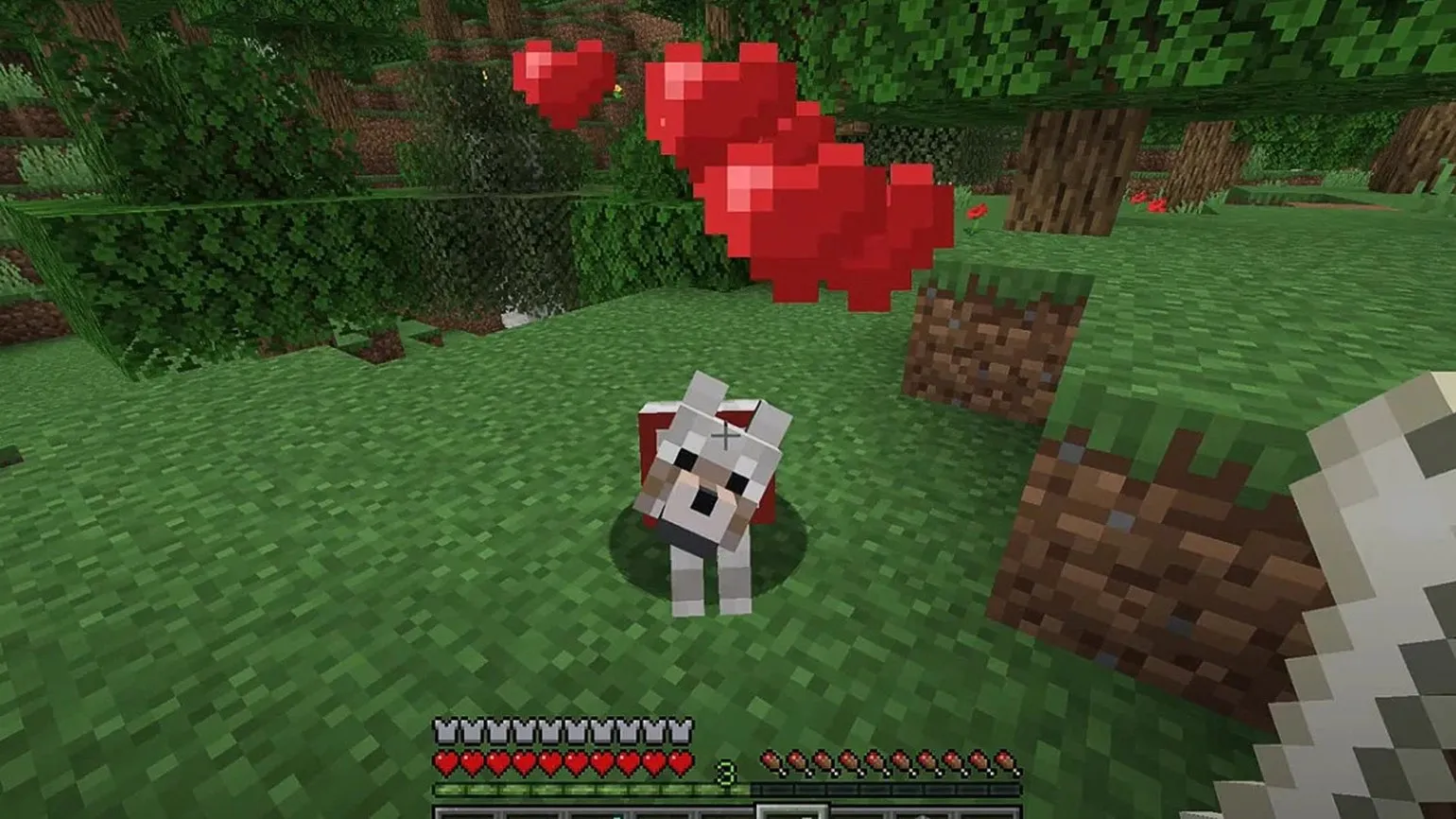
This simplification lies at the core of the mechanics. In real life, romantic attraction is formed through a multitude of details and interactions—glances, casual touches, facial features, scents, conversations, explicit questions, and sincere answers. In relationships, both partners consciously influence their development. However, in a game using the Kindness Coin system, everything is reduced to a mundane and material principle. In this context, love becomes something that can be bought.
Some developers prefer to avoid using coins and opt for more complex approaches to creating natural and multifaceted relationships between characters. Michelle's presentation discusses two new methods, but before moving on to them, let's take a closer look at the Kindness Coin concept.
The coin system operates on a simple algorithm that relies on an internal metric of NPC affection for the player character. This metric influences the player's interactions with the NPC, which, in turn, can open up new possibilities and improve gameplay. The higher your affection level, the greater your chance of receiving unique rewards and quests. Understanding NPC affection mechanics becomes key to successfully progressing in the game. This level increases through displays of affection, such as gifts, compliments, helping, and completing errands, as well as spending time together. These actions can be implemented through dialogue, quests, and game mechanics, fostering deeper interactions between characters and players.
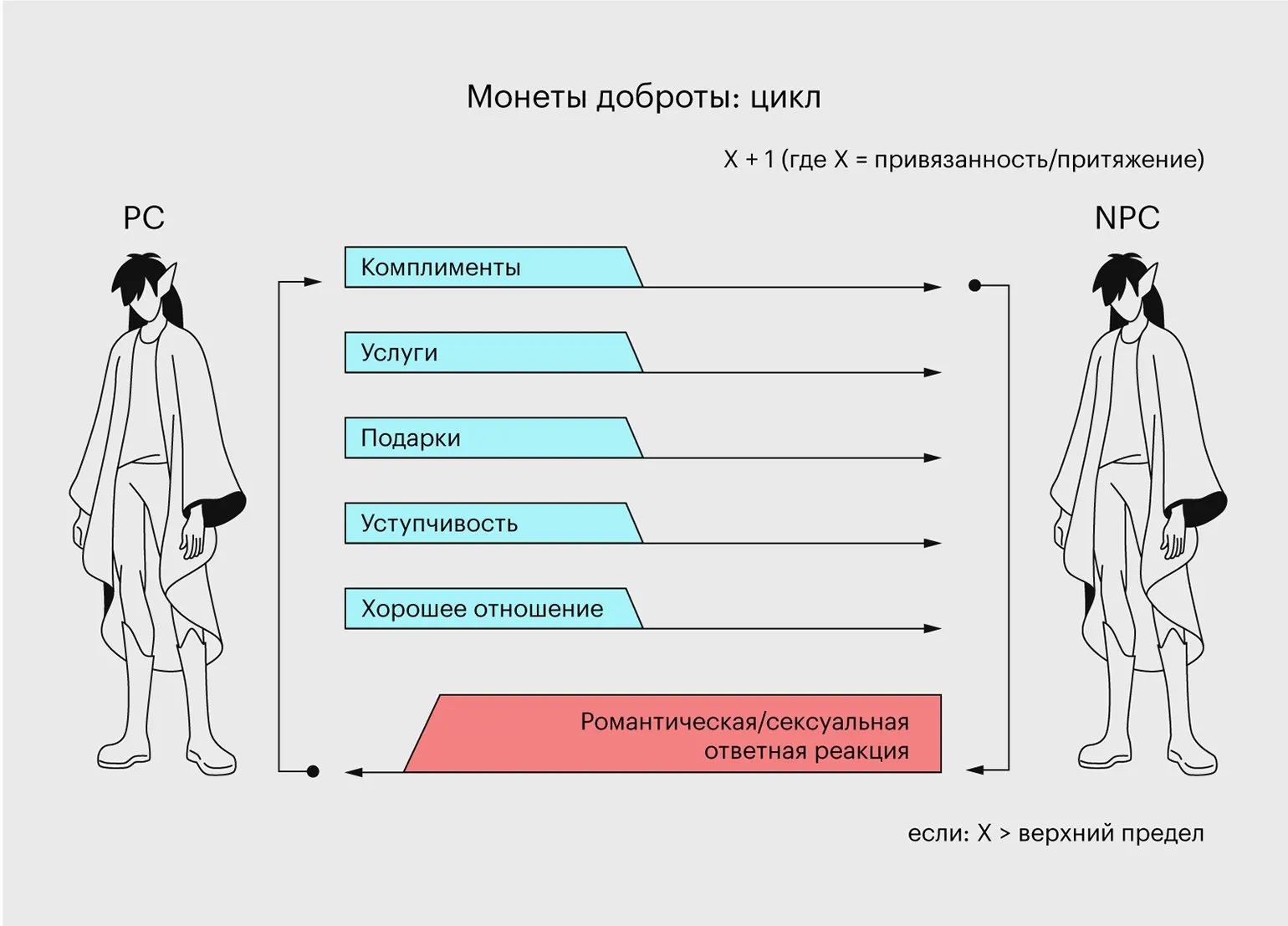
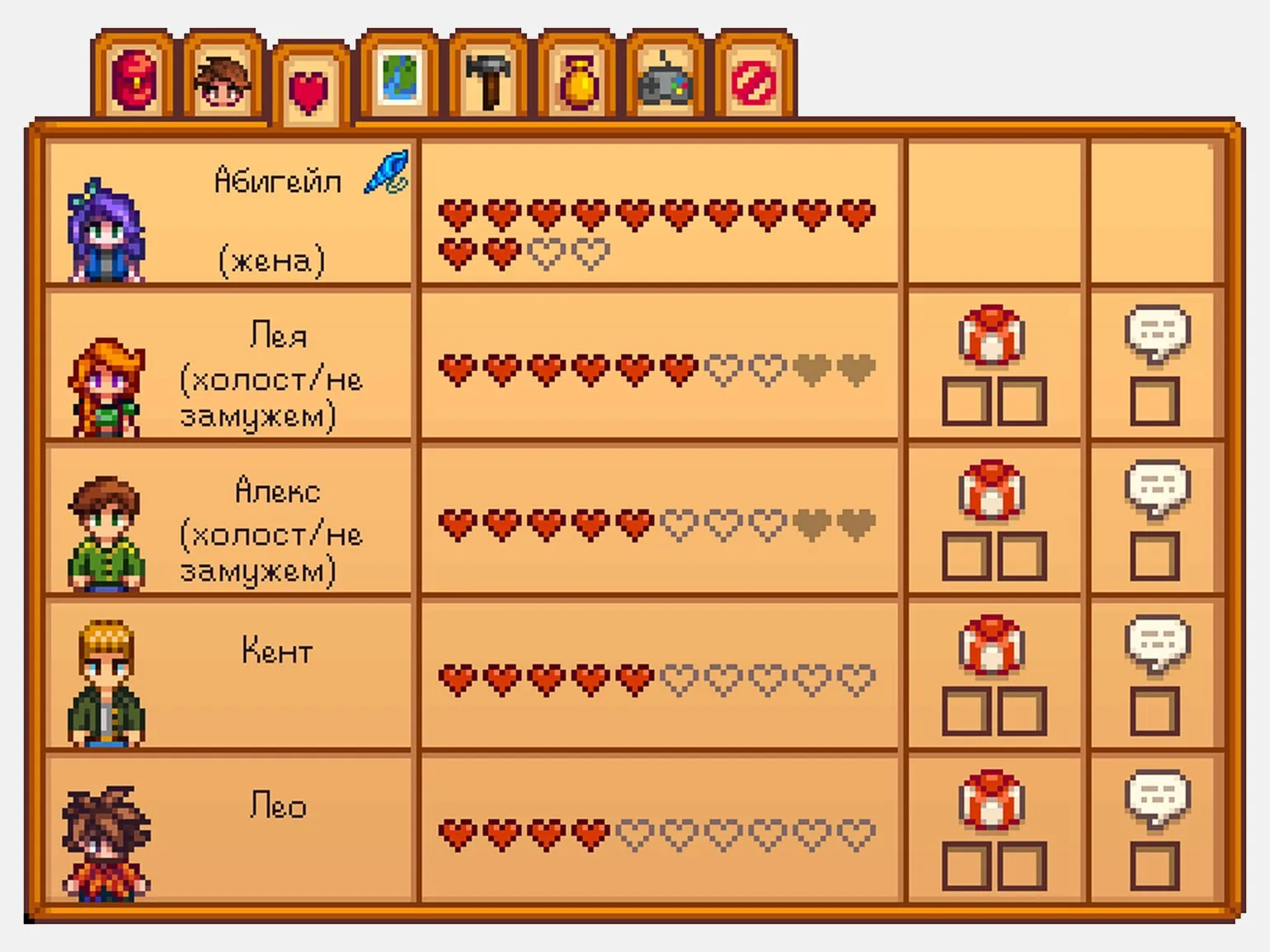
The indicator can be hidden, and its increase will be indicated only by verbal and non-verbal reactions of NPCs. In some cases, this metric may be explicit, allowing players to track progress through menus or temporary pop-up notifications.
When the relationship level between an NPC and a player character reaches a critical point, a new stage of interaction begins. This opens access to new quests and game mechanics, including romantic and intimate cutscenes. The interaction process is repeated: gifts and compliments contribute to the growth of affection, which leads to the next level of relationship. If the branch is completed, the player returns to the main plot, continuing their adventure in the game.
The coin system in the game has a number of flaws that negatively affect the overall narrative. These issues can prevent players from fully immersing themselves in the story and perception of the game world. Ineffective use of coins can reduce motivation and also create an imbalance in the gameplay, which in turn distracts from the main narrative. Improving this system could lead to a more harmonious blend of mechanics and story, which would positively impact the overall experience.
The text doesn't reflect the player character's development. Regardless of the chosen archetype or personality, interactions with NPCs are limited to a single template. Even if your character is an unscrupulous deceiver or murderer, this won't complicate the romantic path. An attractive woman will accept flowers with equal enthusiasm from both a tactful intellectual and a crude mercenary. As a result, there is a lack of character development, which degrades the gaming experience and reduces player engagement. More varied interaction scenarios are needed so that each character's behavior truly impacts the development of relationships and plot twists.
Interactions with non-player characters (NPCs) become flat and repetitive. Typically, each NPC has a unique love story arc, which includes various cutscenes and outcomes. However, when it comes to developing relationships, the process collapses into a standard formula. It's like a vending machine that offers different goods but requires the same currency in the form of good deeds. As a result, all NPCs are leveled, losing their individual reactions and characteristics.
NPCs lack agency, meaning they lack freedom of choice and the right to act in accordance with their own interests. Kindness coins do not imply reciprocated romantic feelings; this romance is fostered by the player, who actively shows the character signs of affection that the NPC cannot refuse.
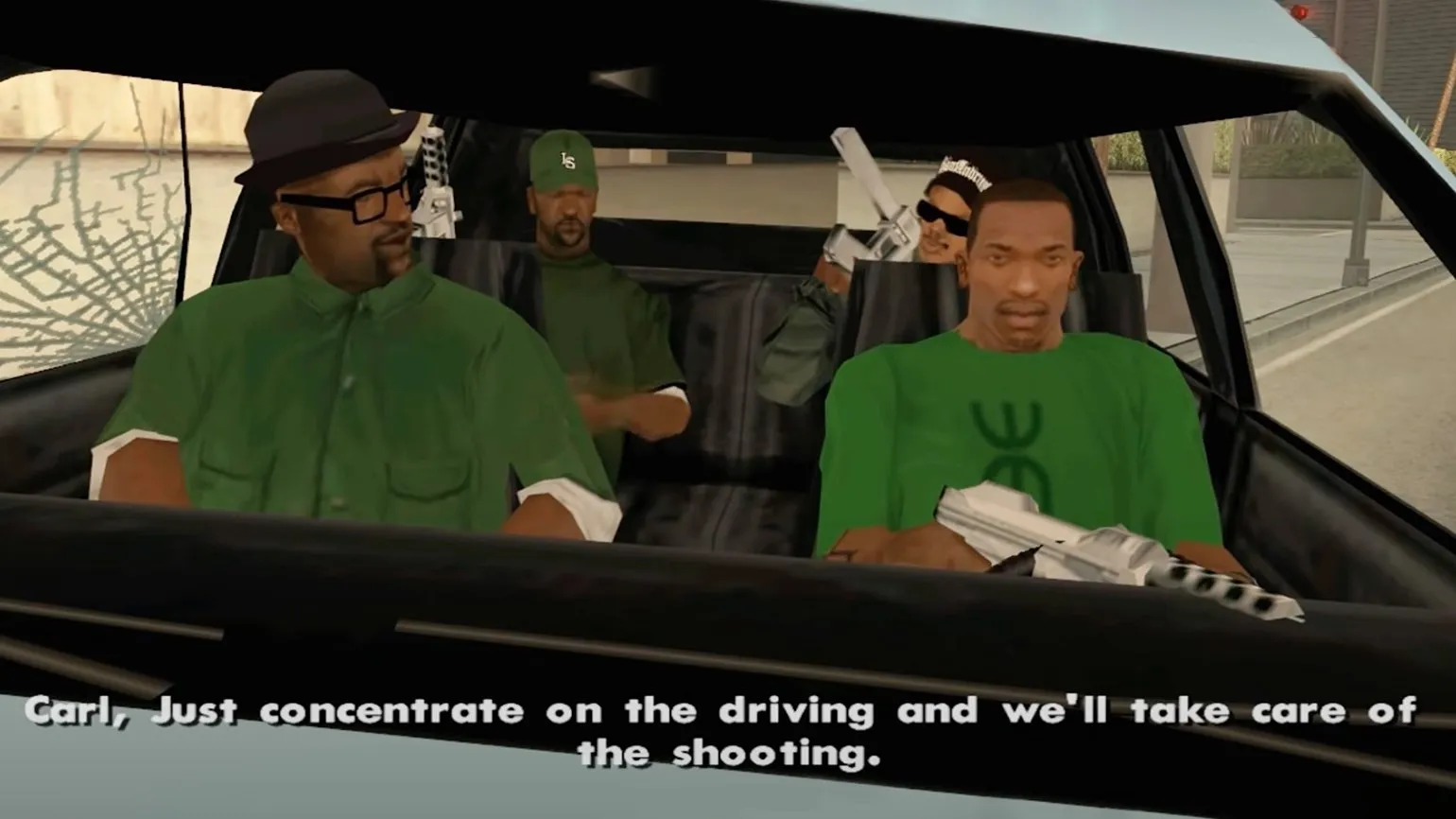
Michelle draws an analogy between romantic relationships and a car speeding down the road. In this comparison, the driver is the player, who controls the car and directs it towards its destination. Next to him sits an NPC who is unable to exit the car or take control. Perhaps the NPC is enjoying the ride and is happy to be driven off into the sunset; perhaps he wishes he could take control. However, until the NPC has his own desires and choices, we cannot know his true intentions. He is on this ride solely because the player has shown interest and attention in him. This emphasizes the importance of mutual feelings and the active participation of both parties in the relationship.
Doesn't differentiate between platonic and romantic interest. According to the coin system, if someone of your preferred gender compliments you, you're supposed to fall head over heels in love and throw yourself at them with open arms. However, in real life, this isn't the case. And that's a good thing, because such a prospect can be terrifying. It's important to understand that feelings aren't always forced and can develop naturally, depending on circumstances and personal connections.
The extreme limitations of the narrative create challenges for writers. If they want to include platonic relationships in the list of variables, then in a system where romantic attraction is the default response to gifts and compliments, this element must be developed separately. Given time constraints, the writer will have to shorten this thread, integrating it into the love template and excluding the romantic aspects. This can result in an awkward situation that undermines the integrity of the narrative.
It is likely that some women have had negative personal experiences that are partly related to the Nice Guy Syndrome. This phenomenon occurs when men expect reciprocal love and acceptance in return for their kind, but often unsolicited and persistent, actions. When these expectations are not met, men may become aggressive, which creates discomfort and negative emotions in women.
In this context, it is worth noting that misunderstandings in relationships sometimes lead to serious consequences. For example, one party may interpret the kindness and care of the other as a manifestation of romantic feelings. This can create false expectations, and in the absence of reciprocity, an emotional reaction occurs that leads to the breakdown of all ties, including friendships. It is important that both parties can overcome such situations without significant damage to themselves. However, in some cases, such misunderstandings can escalate into psychological manipulation, which exacerbates the conflict and harms the relationship. Understanding and open communication are key to preventing such situations.
The coin system has certain advantages that make it widely used. These advantages make it attractive to users, contributing to its popularity and spread across various fields.
The system has a simple design and programming, making it easy to customize without the need for complex coding. It fits harmoniously into a variety of gaming projects, from linear visual novels to multi-level AAA games. At the same time, the system functions effectively and independently, without the need for additional mechanics.
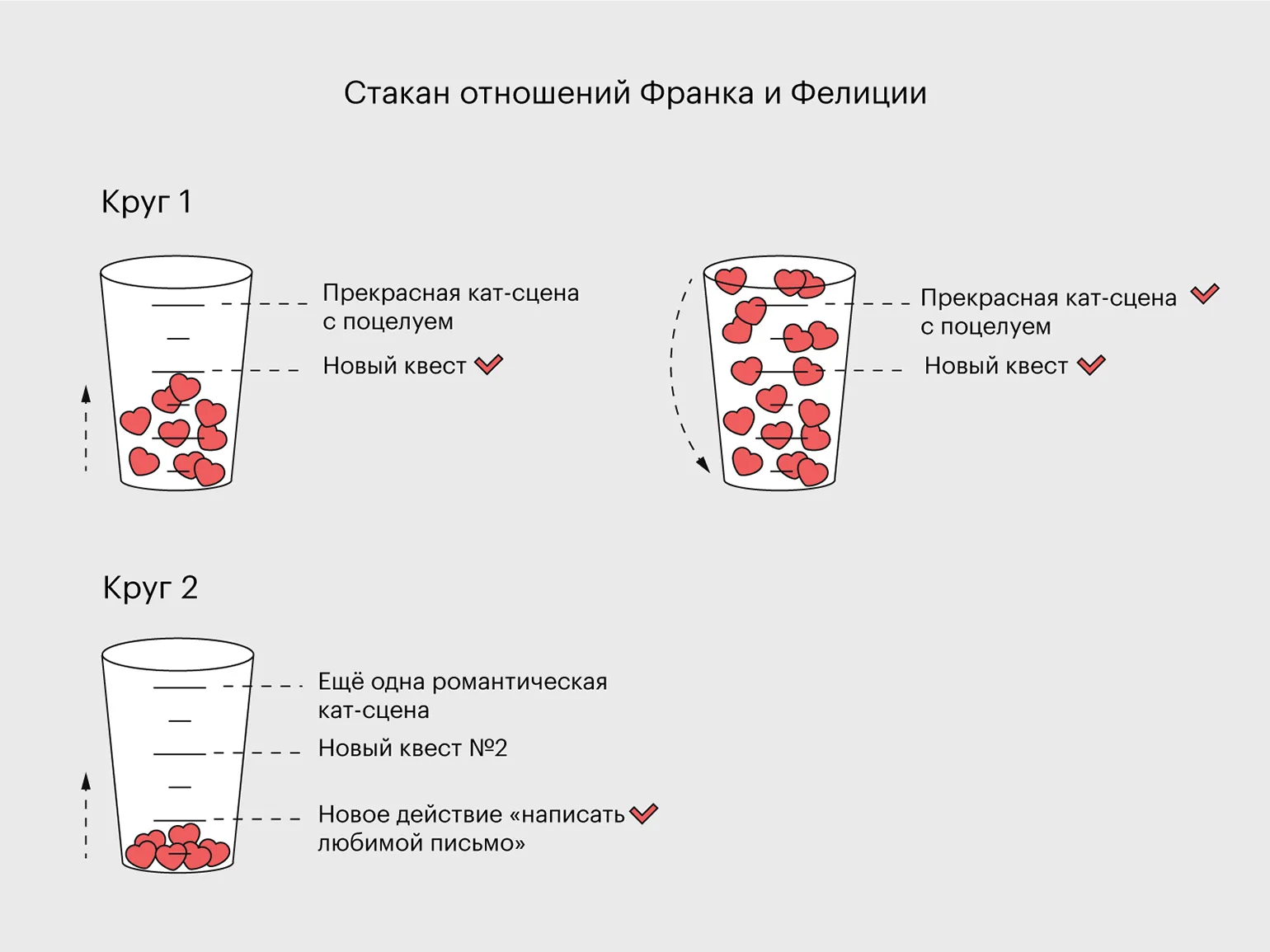
Kindness coins significantly simplify storytelling. Their linear structure makes it easy to manage the development of events: we add coins to a hypothetical measuring cup, and as soon as it is full, we receive a reward, after which the progress is reset, and the cycle begins again. This creates a logical chain for both large and small romantic events, which are introduced into the plot as the cup fills. If necessary, you can easily shorten or expand individual elements, which makes the writing process more flexible and manageable.
Game It significantly simplifies life for players by providing the opportunity to freely interact with characters. It lacks complex mechanics for communicating with NPCs, allowing users to easily establish relationships with any characters they like. For many players, video games become a safe space for fantasy, where they can escape the stress and uncertainty of real life. It's the perfect opportunity to live out their desired scenarios and realize their dreams without unnecessary worry and tension. Michel compares two different approaches to video games: some players prefer complex challenges, such as defeating bosses in Dark Souls, while others choose easier and more engaging games, such as those featuring the character Kirby. Some gamers are interested in experimental projects that deeply explore the complex aspects of romantic relationships, while others seek simple satisfaction of their gaming fantasies. This diversity of preferences highlights how video games can cater to the diverse needs and desires of players.
An Alternative to Coins
Chemistry can be a key driver of narrative. It not only explains complex processes in nature but also serves as the basis for creating engaging stories. Through the lens of chemistry, interactions between substances can be explored, opening new horizons for creativity and scientific knowledge. It is important to understand how chemical reactions can influence the development of plot and characters, giving the story depth and realism.
Michel expands the possibilities of narrative by defining chemistry as any element capable of evoking and developing non-platonic feelings. This can include superficial physical attraction, emotional attachment, true love, or heterogeneous combinations of these. This approach allows for a deeper understanding of the nature of human relationships and emotional connections.
In this context, there is not only freedom, but also realism. Sometimes, both people share mutual feelings and strive for the same goal, which allows them to build a strong relationship. However, there are also situations where interests clash, leading to conflict, drama, and emotional fluctuations. This emphasis on the multifaceted nature of love allows for a variety of stories to unfold, revealing a multitude of reasons, both accidental and intentional, for these feelings to arise, extending beyond simple expressions of interest.
Gameplay possibilities can be significantly expanded if the chemistry between characters extends beyond simple dialogue. Falling in love doesn't just happen through conversation, so it makes sense to integrate this aspect into other gameplay elements. Creating a separate mechanic based on character chemistry can add depth and variety to gameplay, allowing players to explore relationships and emotions in a more complex way. This will not only enhance character interactions but also enrich the overall gameplay experience, making it more engaging and memorable.
Imagine a non-player character (NPC) admiring the player's skill at fighting enemies, wielding a sword, displaying emotions, chopping wood, walking dogs, and conquering kingdoms. Narrative design involves using various game systems to create engaging stories, and this principle should be applied to dating sims as well. By deeply developing characters and their interactions, gameplay can be made more interesting and multi-layered, which will attract players and increase their engagement.
Variety in role-playing. When interactions with NPCs go beyond simple gifts, players are given the opportunity to fully immerse themselves in and develop various roles. This expanded interaction allows for unique gameplay situations and deepens connections with characters, making the gameplay more engaging and multifaceted.
If the player is drawn to unusual and charming characters, this creates a unique opportunity to choose dialogue options and actions tailored to that specific NPC. In this case, the player will assume the role of an eccentric. However, if this is not the case, the player can choose the behavioral style of a lone wolf or an enigmatic bard, which will allow them to attract the attention of other characters. This approach to interacting with the game world opens up new horizons for exploring diverse storylines and relationships with NPCs.
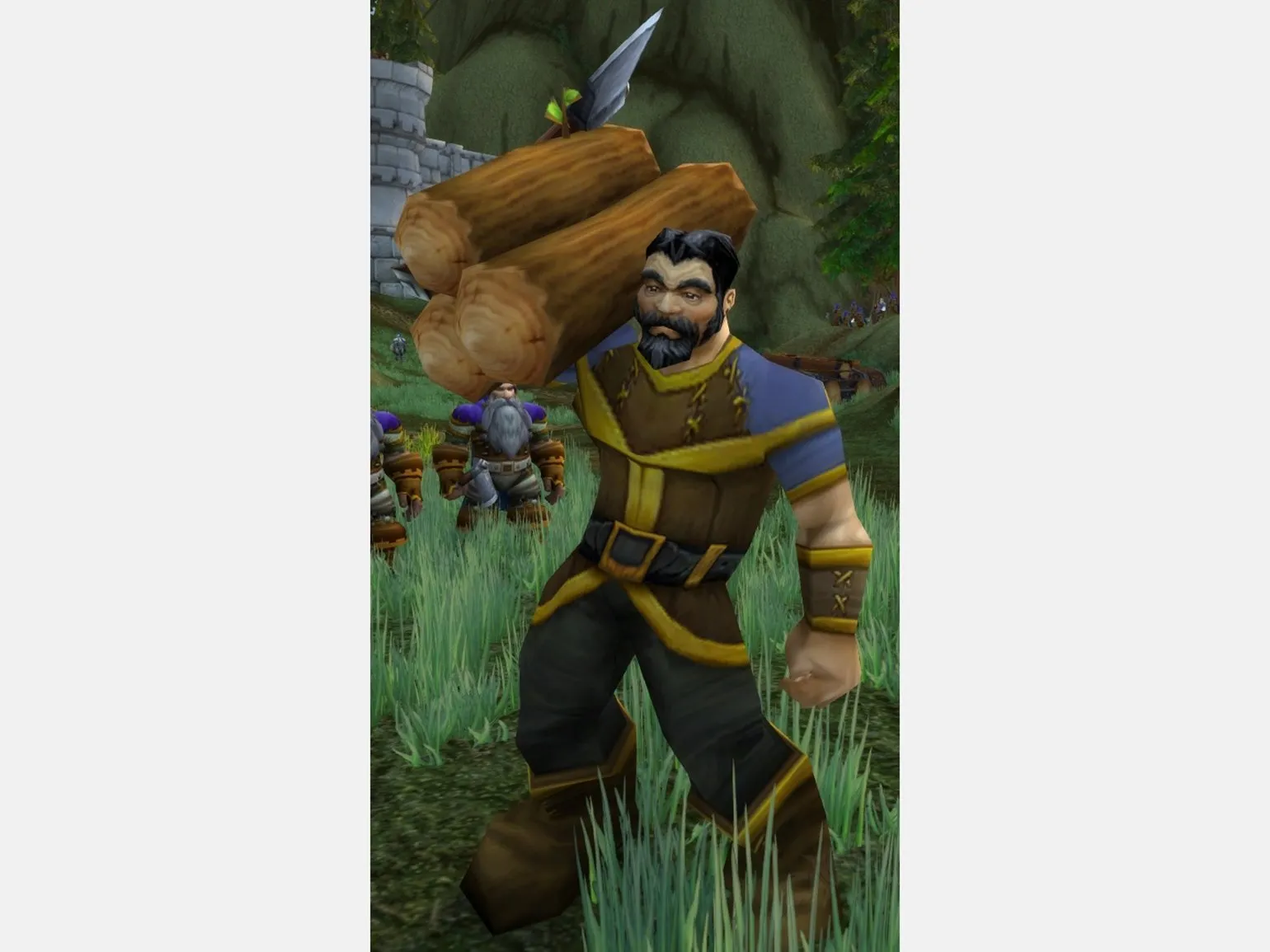
Diverse and multifaceted NPCs create more engaging gameplay. This benefit stems from the realism of the characters: like people, game NPCs can have different preferences that the player must adapt to. Furthermore, as the story progresses, NPCs are able to evolve, changing their views in response to events and revealing unexpected sides. These changes provide a deeper understanding of their personalities, which requires the player to approach each character individually. Creating such NPCs enriches the gameplay experience, adding new layers of interaction and strategy.
The plot can include an aromantic or asexual character with whom it is impossible to establish a passionate relationship, no matter how hard they try. This approach helps readers understand and accept a reality in which romantic connections do not always occur. Including such characters in the story helps expand ideas about love and relationships, demonstrating that interactions between people can take a variety of forms.
Providing NPCs with agency is an important aspect of game mechanics. Character chemistry enables the creation of engaging stories where NPCs don't simply react to player actions but also take initiative. Behavior logic is transformed: instead of simply "I will win their attention," a deeper approach emerges: "I will act in a way that will please the NPC." In this context, the key word belongs to the NPC. Player decisions and actions may inspire characters to take certain actions, but ultimately, they make decisions based on their interests and preferences. This creates more realistic interactions and deepens the game's storyline.
Chemistry Card Tower, or a House of Cards of Chemistry
Michelle's presentation raised an important question: what would happen if chemistry were integrated into the coin system, replacing "good" deeds with it? This approach could open new horizons in understanding the interactions between people and the world around them. Researching this issue allows for a deeper understanding of the influence of various factors on the value system and motivation for behavior.
In response to the request, two new models were presented, one of which is the chemistry house of cards. At first glance, the basis of this system is similar to the concept of kindness coins: the player chooses certain options aimed at attracting a specific NPC. The level of affection grows, and upon reaching a certain threshold, the relationship moves to a new level.
Michel emphasizes that the metaphor underlying the model has a significant impact on the perception of relationship dynamics. This impact affects not only the screenwriters but is also reflected in the stories they create. Understanding the metaphor can change the approach to writing plots and developing characters, which in turn affects the depth and realism of the storyline.
The act of giving coins can be compared to a vending machine, while the house of cards resembles the process of the game itself. The player builds their card tower step by step, adding each new card. With each new step, the tension increases, the risks and drama increase. Each added "brick" intensifies mutual interest until the tower reaches its limit and ultimately collapses, and the characters find solace in each other. This metaphor illustrates how each game is filled with emotion and unexpected twists, creating a unique play space.

The comparison also applies to the reverse process, when instead of construction, a structure is destroyed. Michelle mentions a two-player tabletop role-playing game called Star Crossed, which uses a Jenga tower, reminiscent of a house of cards, as a physical element. This game illustrates how destructive elements can influence gameplay and interactions between players.
The characters experience deep love for each other, but for certain reasons, their relationship remains impossible. Each removed block represents an action that draws one character to the other and evokes strong feelings. Gradually, as blocks are removed, the attraction between them intensifies, and the tower becomes increasingly fragile. At the moment when the structure collapses, the characters stop holding back their emotions and completely surrender to their feelings. This process symbolizes not only their internal struggle, but also the desire for freedom in love, which, despite obstacles, finds a way to manifest itself.
The slides below illustrate the fundamental difference between the two game systems. In the case of coins, the player uses a universal currency, whereas in the context of House of Cards, this currency takes on a specific vector associated with NPCs. Furthermore, the currency itself is divided into several categories: these aren't just abstract gifts and compliments, but unique responses, gestures, behavior, and appearance that may spark interest in specific characters, while being completely insignificant to others. This allows players to interact more deeply with characters and create unique game situations.
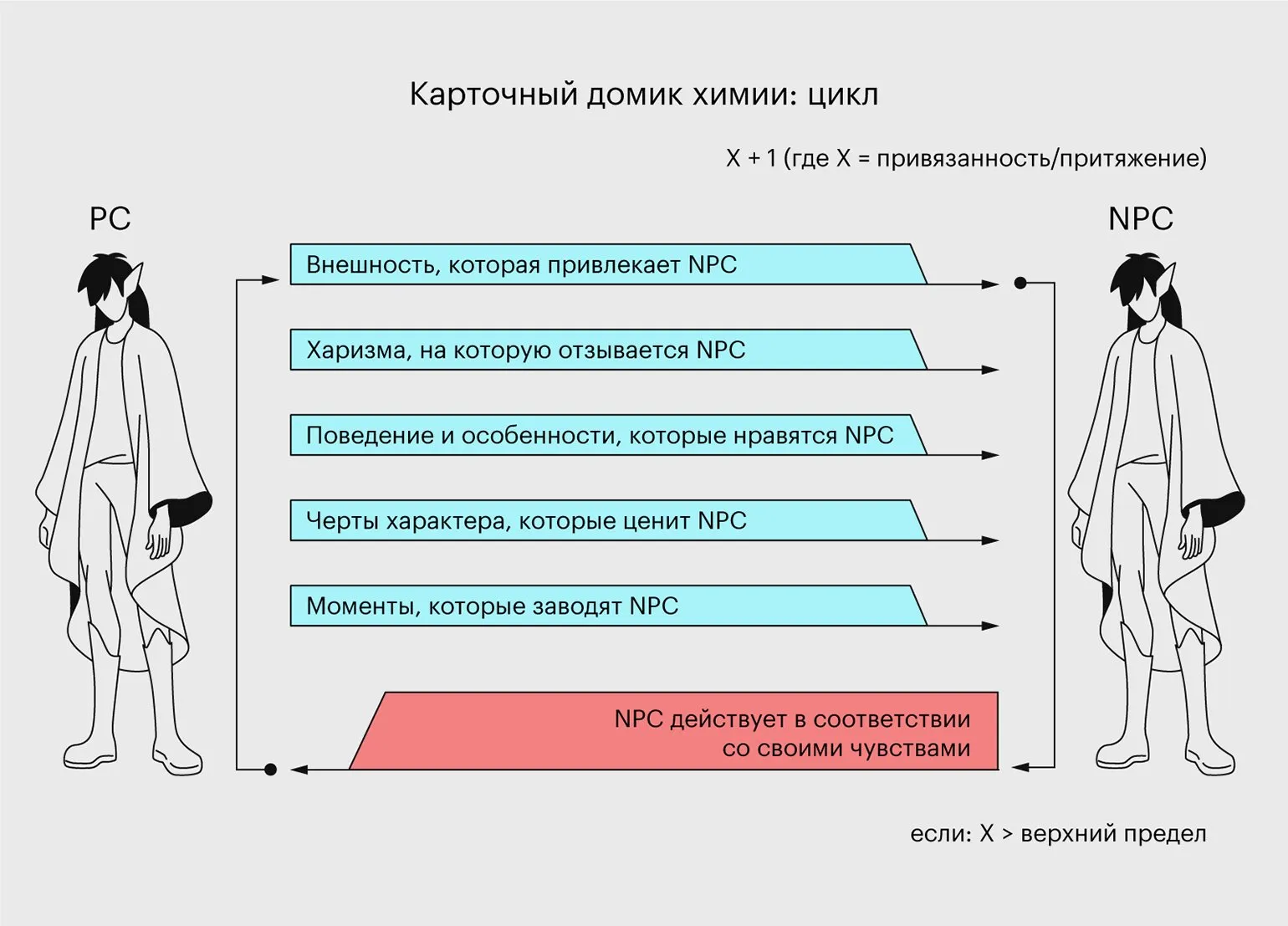
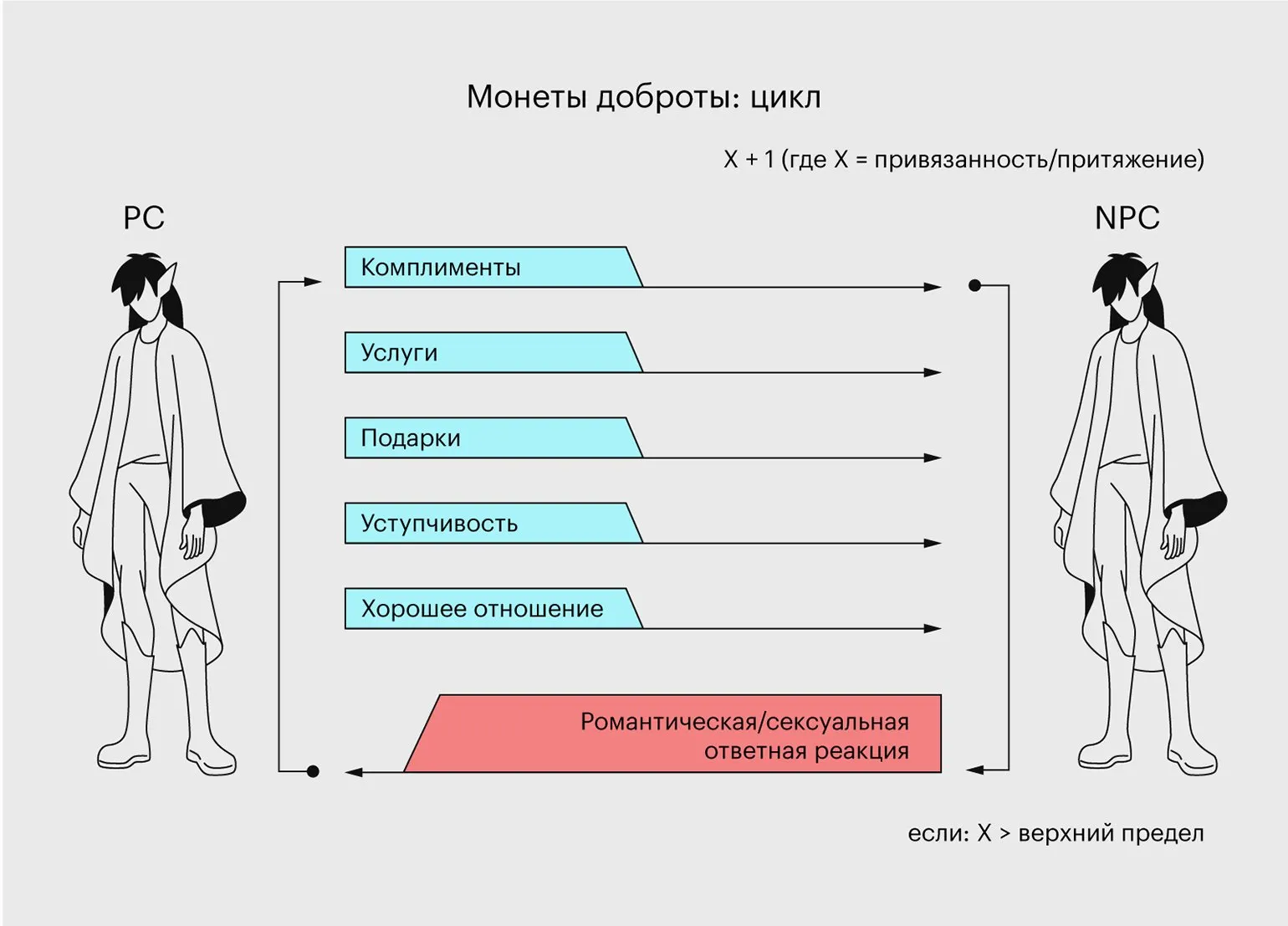
The system continues to provide Clear guidelines for choosing dialogue options and actions that foster NPC likability. Like House of Cards, the emphasis here is on simplicity, but the signs of affection become more individualized and multifaceted, making interactions more realistic. Michel suggests reconsidering and expanding the concept of affection on which the system is based. Instead of focusing solely on sexual and romantic attraction, affection can include many other nuances. For example, a person might be of interest as a close friend. Different personality traits contribute to the formation of trust and respect; some are arousing, while others evoke tender feelings. This broader approach to understanding affection allows for a deeper understanding of the diversity of human relationships and emotions. This creates a deeper connection with NPCs, as they don't simply passively react, but express their desires and preferences. Reaching the limit in the cycle of "signs of affection → growing affection → new level of relationship" means that the character reaches a climax when they can no longer contain their feelings and begin to act. The player's role in this system is to become that unique individual capable of evoking such powerful and uncontrollable emotions in NPCs. This enhances interaction and makes gameplay more engaging and rich.
RPGs and visual novels have become popular genres where coin systems have been successfully integrated. Rather than inventing new mechanics, it makes sense to improve the existing system and add elements of interaction—this is especially relevant when resources and development time are limited. Using coins in these genres allows for deeper gameplay and increased player engagement, which in turn contributes to the project's commercial success.
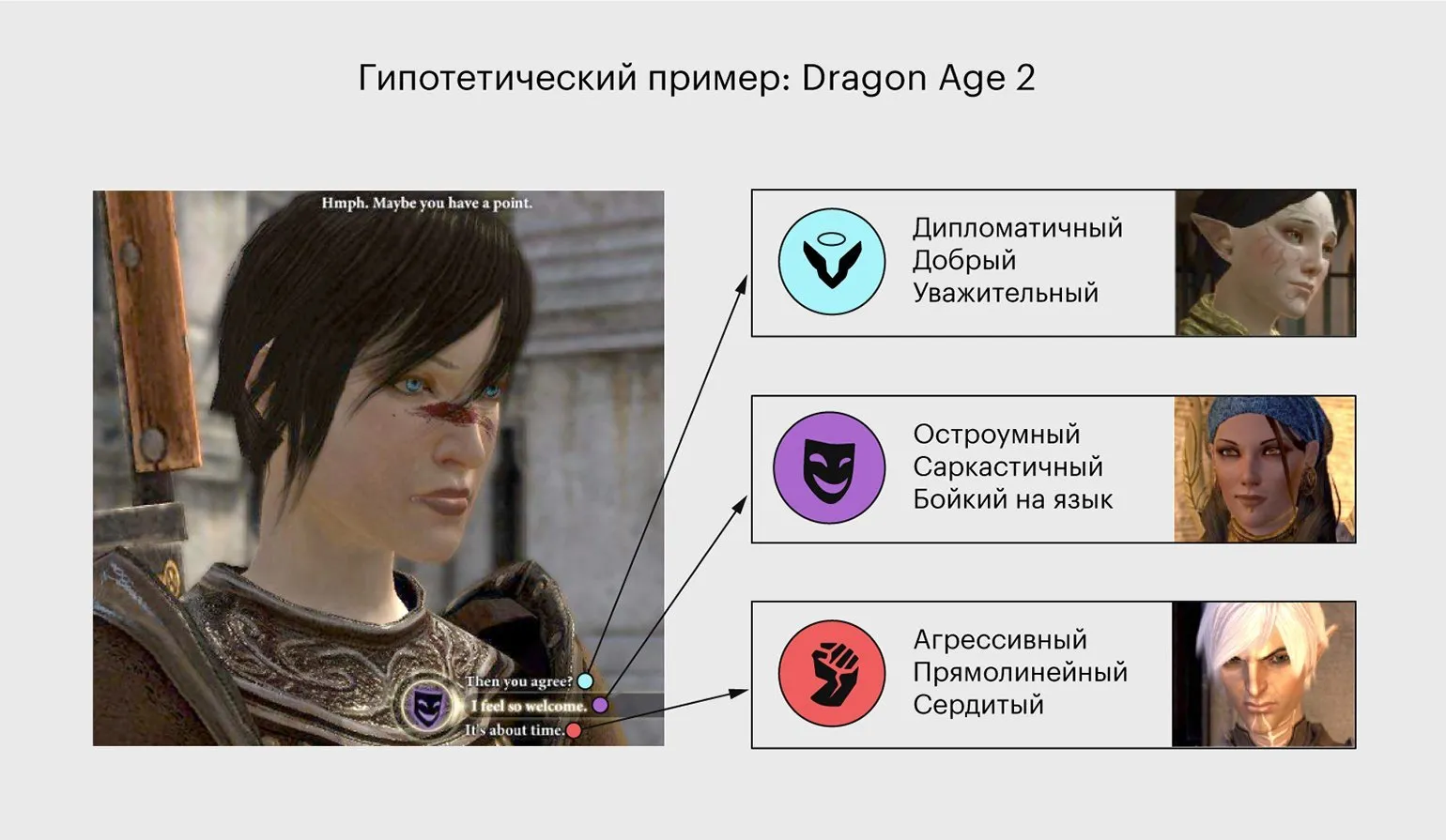
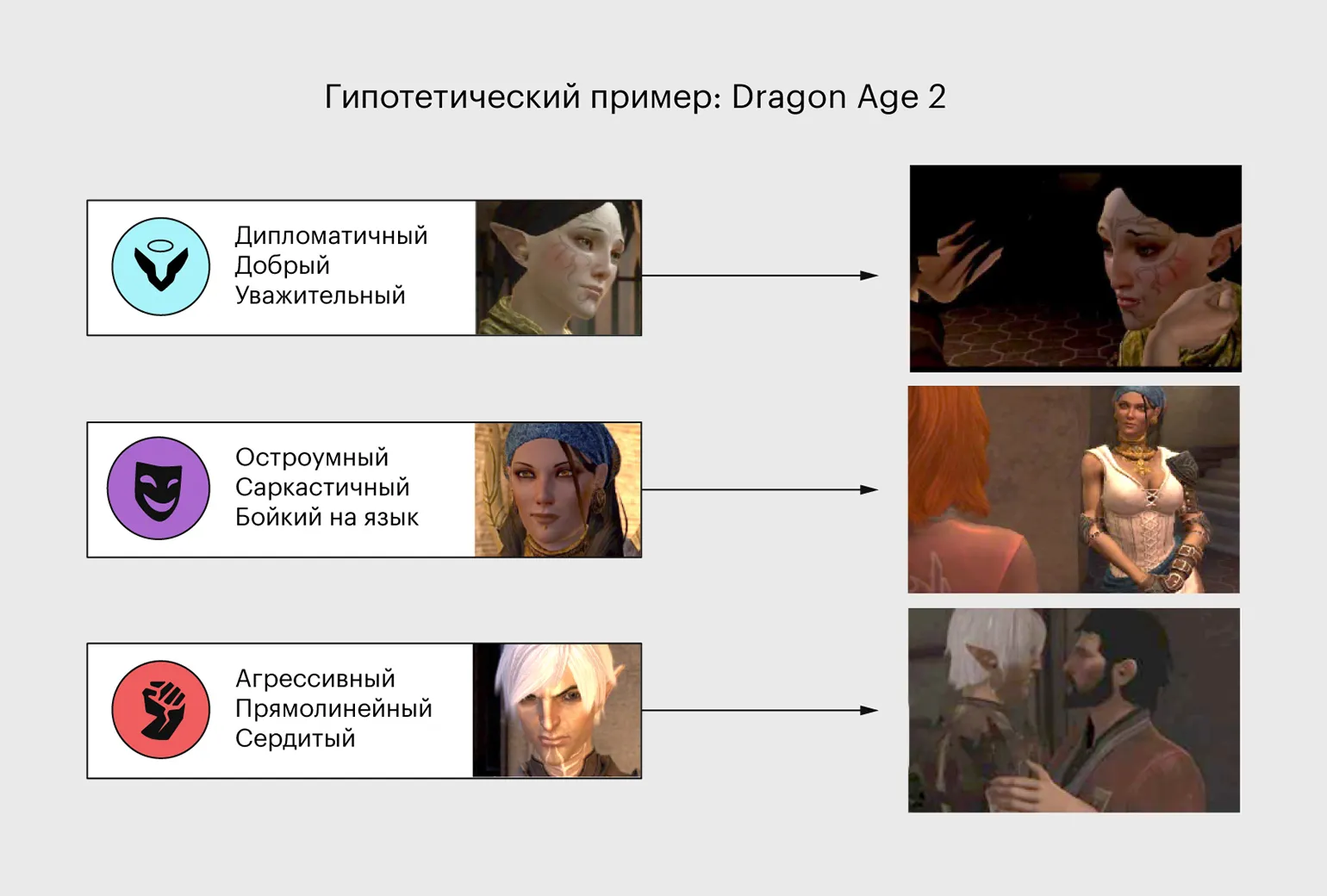
In Dragon Age 2, the dialogue system is organized around three personality types: diplomat, joker, and aggressor. Your character's personality is transformed based on your chosen intonations and dialogue choices, which influences interactions with others. However, it's worth noting that these changes do not affect romantic relationships with companions. This approach to dialogue allows players to delve deeper into the game world and develop unique communication strategies, while still maintaining the character's personal life.
For the relationship system to function effectively, it's important to tie it to three personality types that will attract specific partners. This will add additional context and dynamics to romantic storylines based on the protagonist's personality. This will result in unique interactions and cutscenes that span a range of emotional tones, from passionate to delicate and frivolous. This approach will not only enrich the storyline, but also create a deeper connection between the characters, making the gaming experience more engaging and memorable.
Simplified love stories focus on themes of relationships and emotional intimacy, excluding complexities such as unpredictable reactions Non-player characters (NPCs). In such narratives, the reader is always clear about the decisions to be made to achieve the desired outcome. These stories create an atmosphere of comfort and predictability, allowing you to focus on the development of relationships and emotional connections between characters.
Games that focus on the desires and fantasies of players present simple and idealized stories. These games allow users to immerse themselves in a world where their dreams and aspirations can come true. The simplicity of the plot makes them accessible and attractive to a wide audience, allowing each player to feel like the hero of their own story. Idealized scenarios create an atmosphere in which players can enjoy adventures and experiences without complex moral dilemmas and intricate plotlines. Such games are a great way to escape the daily routine and temporarily immerse themselves in a world of vivid emotions and exciting events.
When Even More Realism Is Needed
House of Cards Chemistry creates the illusion of reality, but does not fully reflect it. What should someone looking for a true challenge do? Perhaps, as a developer, you seek to explore not only simple and understandable emotions, but also complex, multifaceted feelings. This could be love full of contradictions, unstable ground under your feet, chance occurrences and paradoxes that make life unpredictable and interesting.
In everyone's life, there are moments when they reflect on their path, goals, and the meaning of existence. These reflections can be related to various aspects: career, relationships, personal development. It is important to understand that life is an ongoing process, filled with both joyful moments and challenges. Every experience, both positive and negative, shapes our personality and helps us grow. When considering your life priorities, it is worth paying attention to what is truly important to you and striving for harmony in life. This includes not only professional achievements, but also peace of mind, relationships with loved ones, and the desire for self-improvement.
- Simple luck and chance. Sometimes love comes just because. Because one day I forgot my umbrella and it started pouring rain. Because I stayed late at work on Thursday and missed the last bus. Because I completely by accident took a ticket for the seat next to me at a great height, as Alexander Vasiliev sang. Random moments happen everywhere, every minute of every day, and they are impossible to predict or plan. You still have to be lucky to meet the right person at the exact moment when you are ready for this person.
- An inexplicable spark. Attraction, too, can neither be explained nor fabricated. Even having met a seemingly ideal person in your eyes, you may simply… not feel the necessary connection. And what can you do?
- We always move blindly. And in fact, we have no idea how to navigate the endlessly complex relationships with other people, or in life in general. We act as we want and think is right, but what will come of it - no one can say in advance. So we walk day after day through a foggy sea, carefully skirting the reefs and trusting our intuition.
In conditions of uncertainty, we continue to move towards our desires and dreams, encountering random doors and forks along the way. How can this feeling be conveyed in gameplay?
Chemistry Casino, or Chemistry Casino
The second model, proposed by Michelle, is a chemistry casino, where randomness is an important element. Here, we are talking not only about random number generators (RNGs), but also about hiding information from the player, which creates the illusion of unpredictability. This model emphasizes how the perception of randomness influences game processes and the decision-making of participants.
In coin-operated and house-of-card games, the impact of choices and the level of commitment to the process are obvious, but in a casino, these dynamics are less transparent. Players make decisions based on intuition and assumptions about the possible consequences of their actions, striving to achieve the desired outcome. If the game uses a random number generator (RNG), even the right choice does not guarantee success, which adds an element of uncertainty and increases excitement.
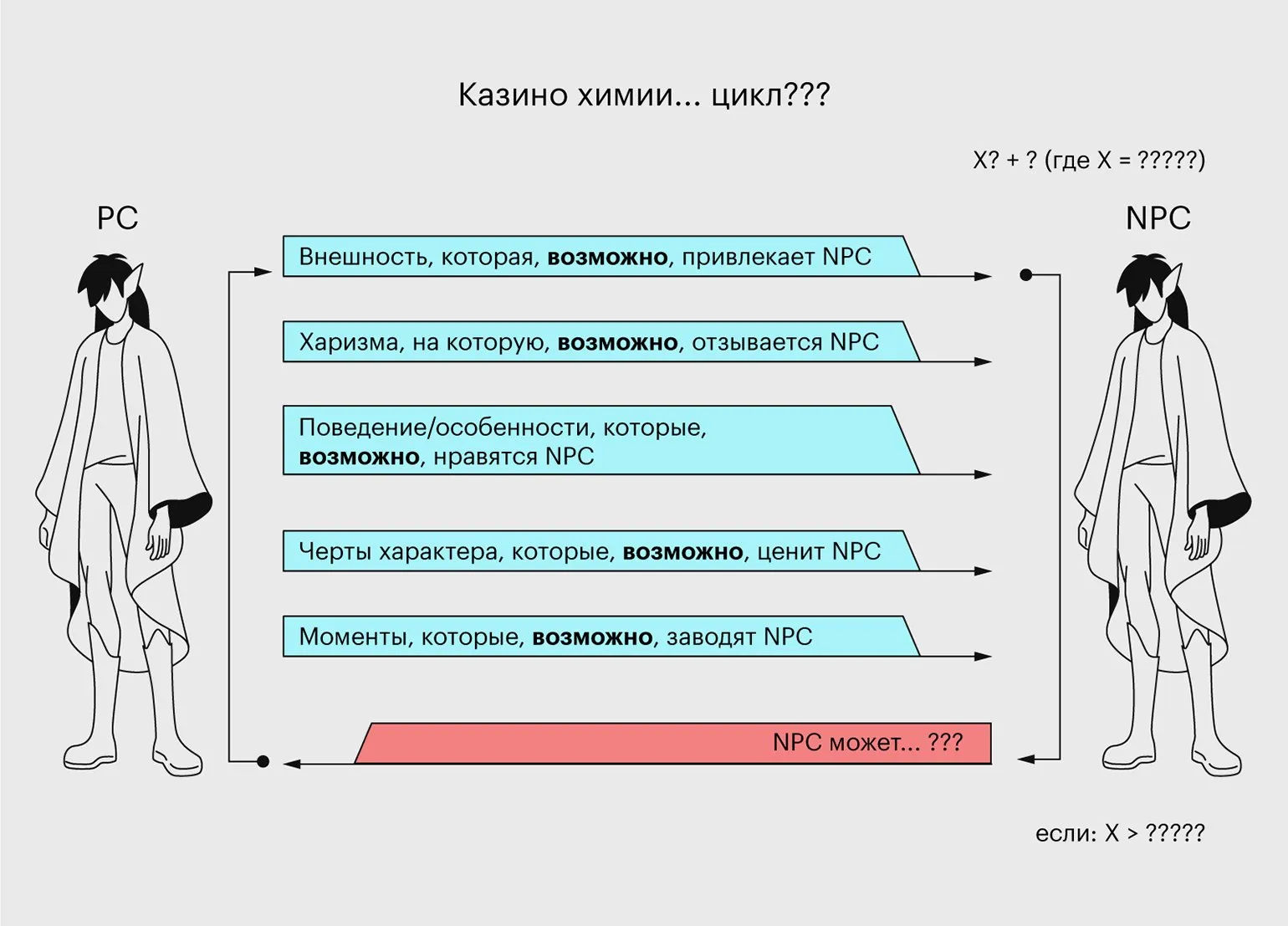
Chemistry Casino continues to inspire players to role-play and explore interactions within the game world. How does following the Samaritan's path affect the plot? What happens if you regularly visit a favorite NPC? These questions capture attention and encourage players to delve deeper into the game's dynamics, discovering new possibilities and scenarios. Exploring such aspects makes gameplay more engaging and varied.
This exploration takes on an experimental nature thanks to unexpected results. For example, a non-player character (NPC) may exhibit restraint or inconsistency in their reactions. Such signals can indicate both a lack of rapport and personality traits that do not preclude the possibility of reciprocal feelings. In this situation, the player is left to guess at the reasons for the NPC's behavior and continue their attempts at interaction.
A casino with a random number generator (RNG) can be compared to the rolls of the dice in tabletop role-playing games. In this context, your character's attributes, such as courage or charisma, act as positive modifiers that increase the roll results. This creates an element of uncertainty and randomness, inherent in both gambling and role-playing adventures. Players can rely on luck, but must also consider how their strategies and skills can influence the outcome. Thus, an RNG casino offers a unique experience where every roll can lead to unexpected results, making the game even more exciting.
The number of positive modifiers increases the likelihood of a successful outcome, but does not guarantee it. You roll a die to determine whether a spark has been ignited between your character and an NPC. A 20 means the connection has not only been established but has developed into a true flame. A 1, on the other hand, indicates that no bonuses will help you.
Negative modifiers associated with repulsive traits do not always lead to failure. If you achieve a high enough result, you can attract the attention of an NPC despite your disadvantages. This reflects reality, as falling in love is not always a conscious choice.
A casino with a random number generator (RNG) is ideal for games that already have elements of randomness and procedural generation. For example, in the strategy game Crusader Kings 3, random events and unique characters create a dynamic system of romantic relationships, turning the gameplay into something resembling a soap opera. The game features unpredictable wars, betrayals, infidelities, and even illegitimate children. In addition, players may experience the death of rulers from disease or excessive alcohol consumption, which adds additional depth and intrigue to the gameplay.
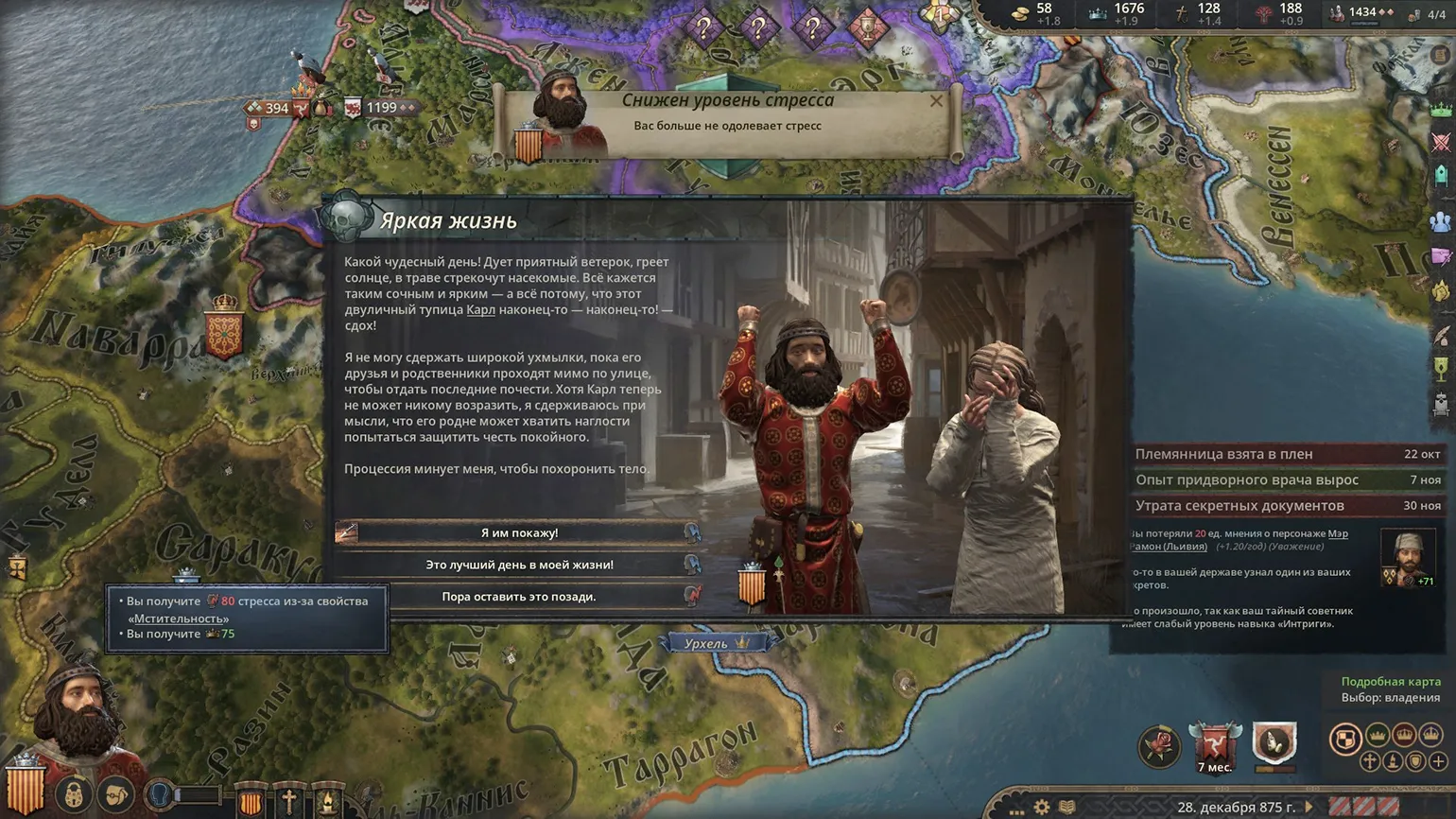
Games with linear plots and limited content are less suited to this model. Firstly, most players will not be happy with being deprived of the opportunity to develop relationships with NPCs due to random circumstances, especially if they have already invested dozens or even hundreds of hours into the game. This can lead to frustration and a negative perception of the gameplay. The importance of interaction with characters in such games should not be underestimated, as it is a key element that can significantly impact the overall gaming experience.
The randomness inherent in the RNG (random number generator) mechanism significantly complicates the work of writers, and in some cases makes it impossible. Traditional coherent stories rely on a clear structure based on narrative logic and the sequence of events. The introduction of random elements can disrupt these connections, disrupting the harmony of the plot and the pace of events. This creates additional challenges for writers seeking to create deep and engaging stories. Michel offers writers a hybrid randomization model, which includes two options. This model combines elements of randomness and predictability, which contributes to more engaging and varied plots. The hybrid approach provides greater flexibility in script development, allowing writers to experiment with different storylines and characters. As a result, writers can create original content that will attract audiences and maintain their interest. Modular storytelling is a unique approach to creating game narratives. It includes self-contained cutscenes and events that seamlessly integrate into gameplay, independent of random generation. This approach allows for the development of strictly limited sets of random elements, making them easier to track and manage. A modular storyline creates a more structured and predictable gaming experience, which can increase player engagement and enhance the overall experience.
Monster Prom is an excellent example of a dating sim, where players strive to win the affections of NPCs in order to attend their high school prom with them. Chemistry plays a key role in this gameplay: characters' acceptance or rejection depends on the level of the NPCs' preferred stats. Players can develop individual stats during special scenes and challenges, but their appearance is random. If the player doesn't choose the right sequence of events, they may have a hard time finding a suitable prom date. This game attracts attention thanks to its unique mechanics and interactive elements, which makes it interesting for fans of the dating sim genre.
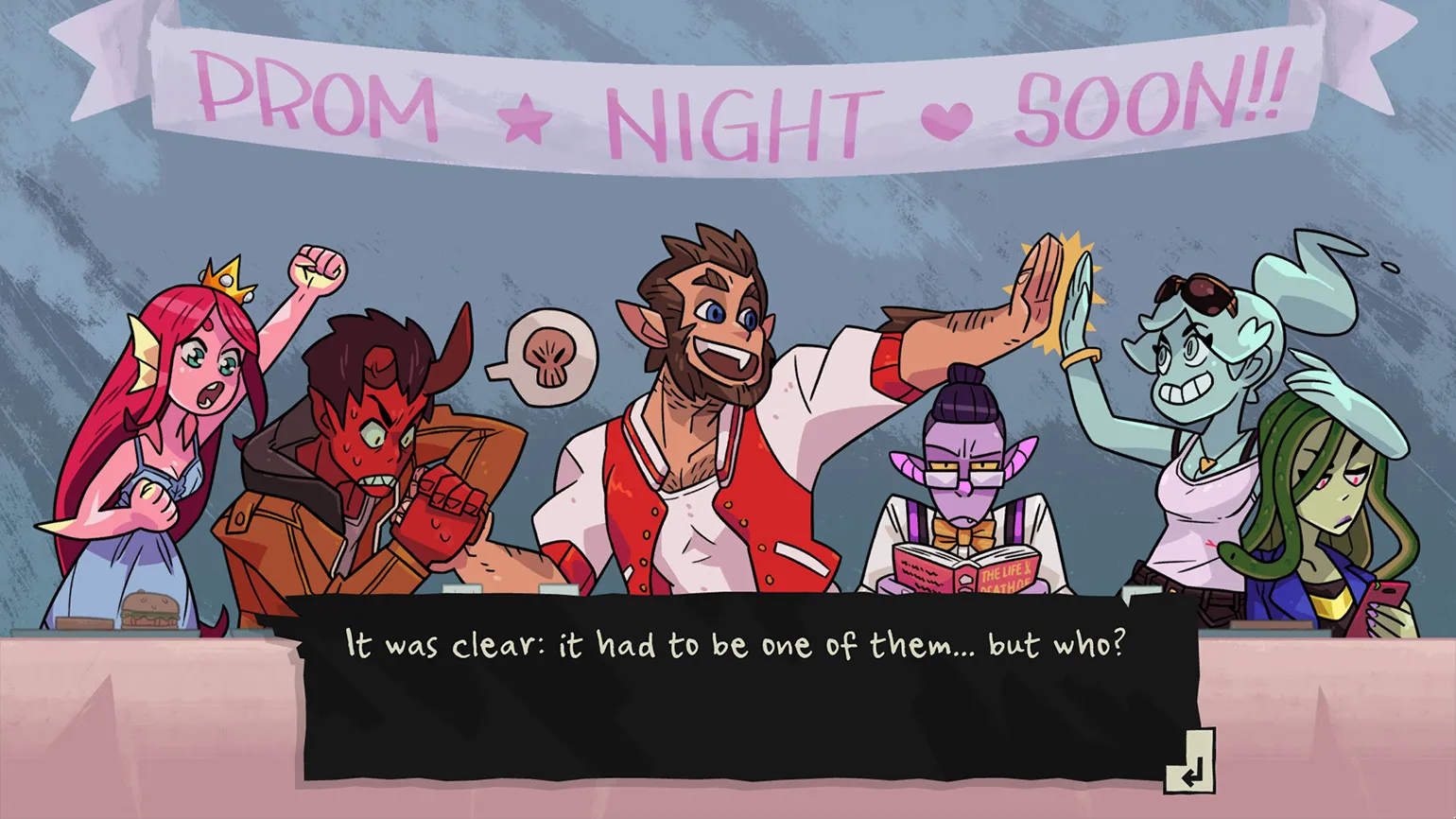
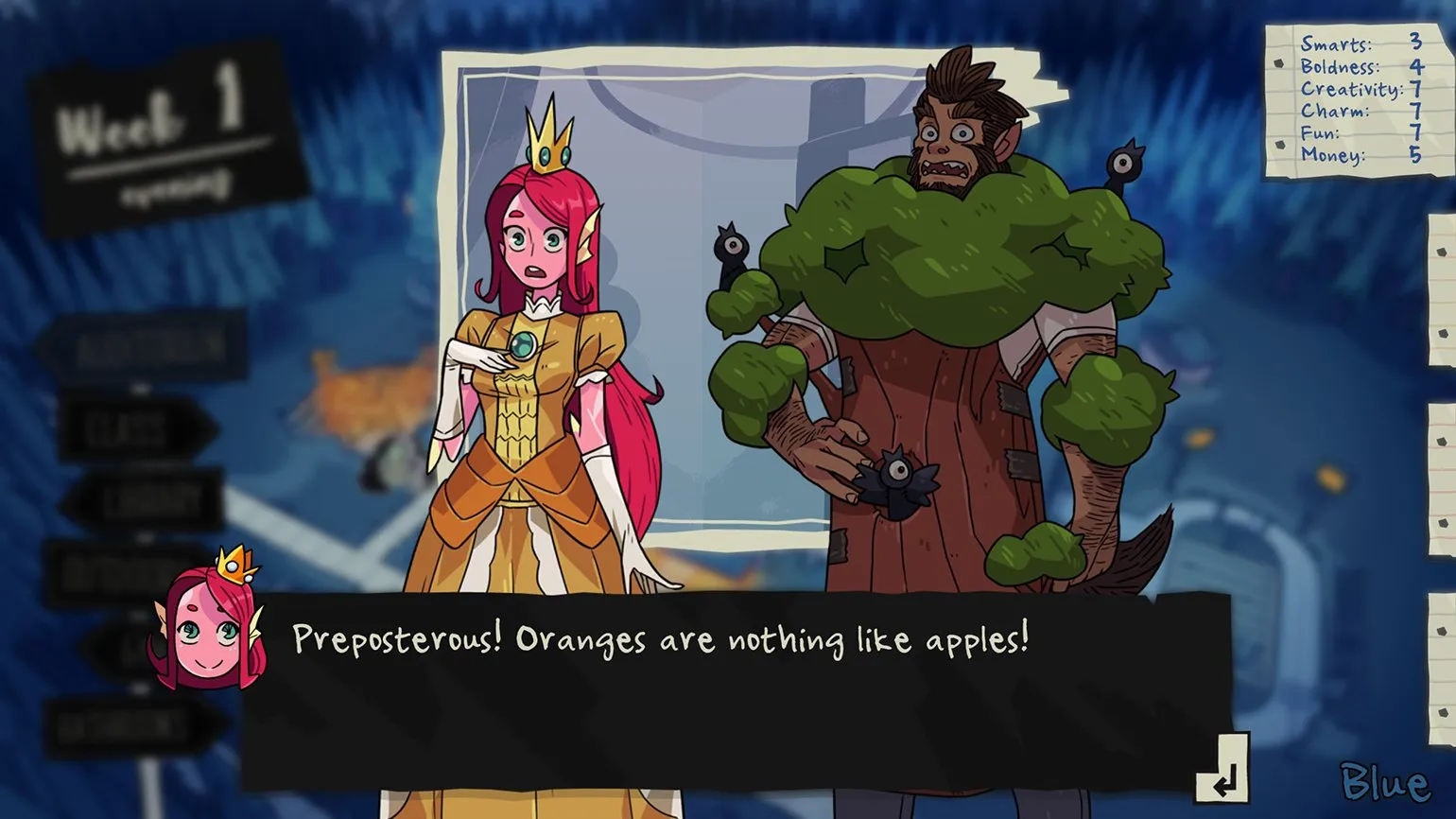
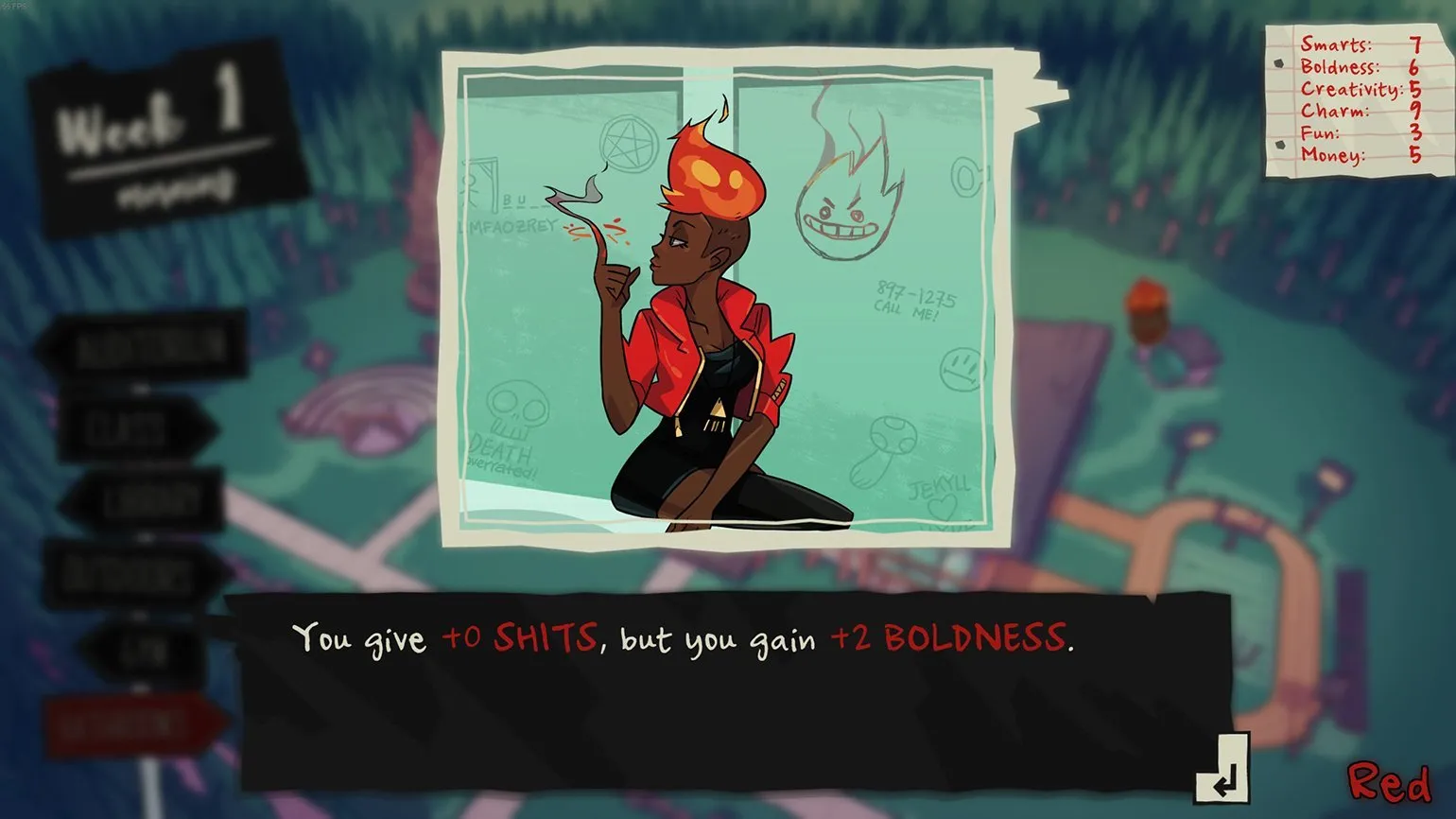
Simplified randomization integrated into the plot includes random timings, slight variations in events, and minor details that do not significantly affect the development of the story. This approach allows writers to focus on the core aspects of the narrative, facilitating the writing process and improving the overall experience. Randomization in this context helps maintain viewer interest without distracting them from the main plot lines.
A chemistry-based casino game doesn't use actual randomization mechanisms, but creates the illusion of randomness through a carefully crafted narrative. The writer's primary goal is to create a plot that evokes a sense of luck and unpredictability in the player. This makes the gameplay more engaging and rich, helping to retain player interest and increase their involvement.
This method may seem unfair, but it overcomes potential limitations. With skillful script development, planned twists can surprise most players just as if they were randomly generated. This approach not only adds an element of surprise but also makes the gameplay more engaging and dynamic.
Remember that for any scam casino, there will be someone who can expose it and create detailed instructions on how to complete the game. Don't be upset when this happens. Be careful and aware of the risks associated with gambling, and always check the casino's reputation before playing.
Hide from the player any information that might indicate that their choices affect NPCs. This includes various elements that can hint at the consequences of the player's actions, such as changes in dialogue, character reactions, or in-game events. This approach helps create a deeper immersion in the gameplay, increasing the level of engagement and interest in the story. Effective implementation of this element can significantly enhance the gaming experience and make it more engaging.
UI. Effective dialogue options, pop-up hearts, indicators, gauges, and counters—create an atmosphere of suspense by disabling all cues and leaving the player in the dark. This approach heightens tension and creates the potential for romantic or sexual tension, which can significantly increase engagement and interest in gameplay.
Obvious NPC reactions, both verbal and nonverbal, play an important role in creating character depth. Instead of using standard reactions like a joyful exclamation or physical actions like a slap, an NPC might simply smile slyly or raise an eyebrow. This leaves room for interpretation and adds an element of mystery. It's important to veil emotional reactions, making them meaningful and expressive not only through words but also through body language. This will help create a more engaging and intriguing gaming experience.
Michel cites the example of the visual novel First Bite, in which the protagonist finds herself in the house of three vampires. A night spent in their company can turn into either romance or tragedy. In an atmosphere of danger, flirtation takes on an ambiguous character: a captivating smile can signal either affection or the fact that one vampire is playing the role of predator and the other the prey. This play of emotions and intriguing interactions makes First Bite a captivating visual novel experience.
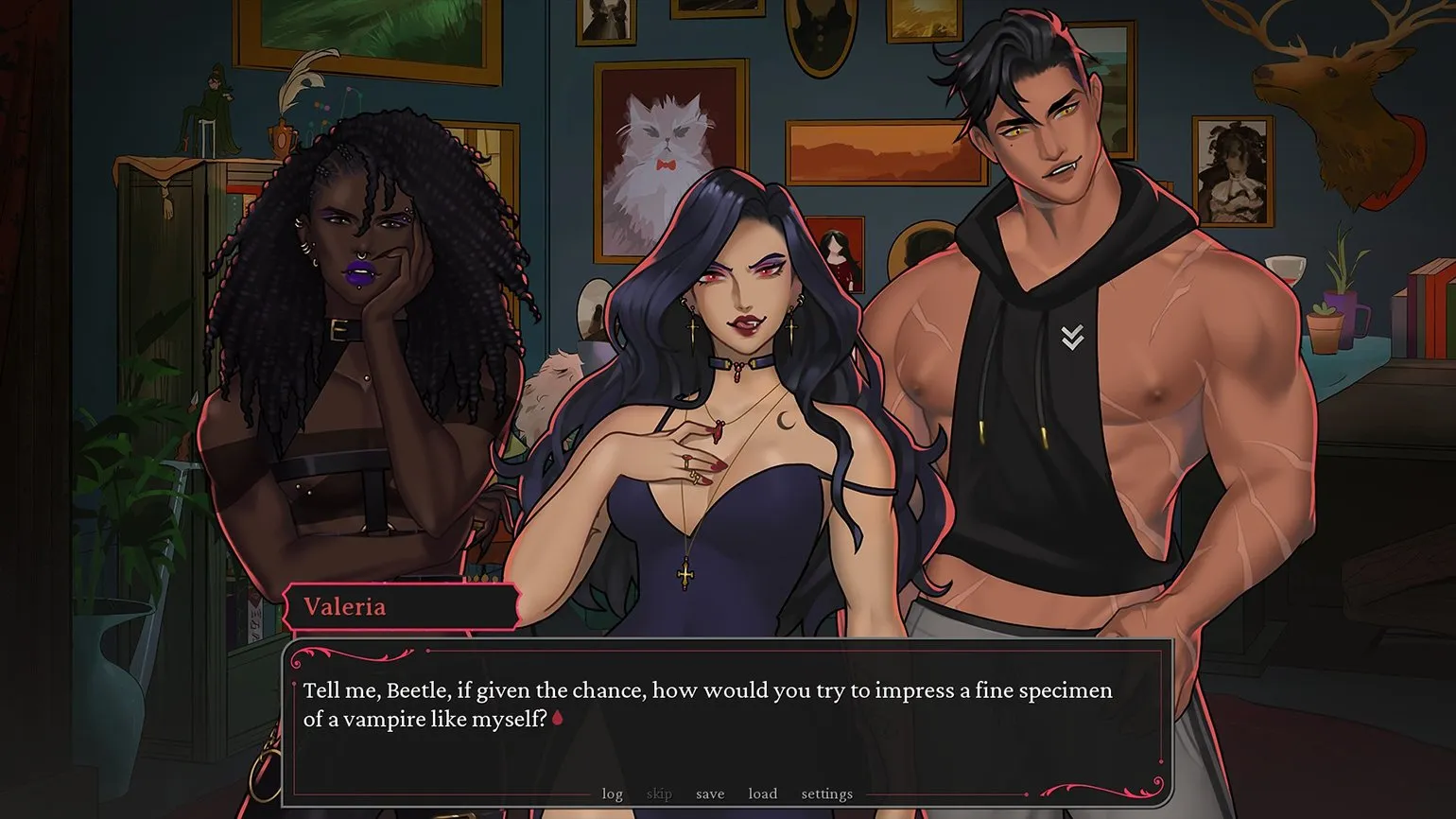
To create a fake casino, you can use various scenario templates and techniques that involve unexpected twists. These elements will help make the gameplay more exciting and interesting for participants. It is important to think through storylines that can include unexpected events and intriguing endings. This approach will not only increase fascination but also attract players' attention, which in turn will have a positive impact on the overall popularity of the casino. Using unconventional plots and unexpected twists will help distinguish the fake casino from its competitors and create a unique gaming experience.
- In the footsteps of detectives. In crime stories, players identify killers and their motives. In love stories, they explore the feelings that the NPC has for the character and possible complications.
- He loves her – he loves her not. The dynamics of the relationship are structured in such a way that both outcomes seem equally possible, and the result is unknown until the last petal.
- And miracles happen. Stories of incredible luck, random coincidences, leaps of faith—even add a deus ex machina to bypass the players' precise calculations and allow victory when failure seems inevitable.
Conclusion
In conclusion of her presentation, Michelle notes that the models she proposes are not the only options and are not new developments. If these approaches do not fit your game, they can serve as a reliable foundation for creating new game systems.
Love relationships require a complex chemistry of interaction, not a simple exchange like in a vending machine. True love is not a transaction or a simple equation with one obvious variable. It is based on deep feelings, mutual understanding, and an emotional connection that cannot be reduced to simple calculations. Success in love depends on many factors, including trust, support, and shared experiences. These are the elements that create true intimacy and harmony in relationships.
Of course, I'm happy to help you revise the text. Please provide the source text you wish to revise.
When choosing an approach to game design, prioritize deep and multifaceted interactions over superficial and understandable actions. Respect the subjectivity of your NPCs and use all available game mechanics to create romantic and erotic stories. Pay attention to the differences between random and predictable elements and their impact on game design and narrative. Develop simple yet engaging games that inspire players and spark their imaginations. Don't forget about more complex projects that can explore realistic concepts. Create game systems that evoke an emotional response, compose scenes that inspire adventure, and write stories that will lift players to celestial heights.
Profession Narrative Designer
You will learn from scratch how to create scripts for games, invent characters, write dialogues and convey ideas through gameplay. You can earn money in game development and implement the game project you've always dreamed of.
Learn more