Contents:

Learn: Unity Game Developer Profession from Scratch
Learn MoreSubscribe to our Telegram channel "Checkpoint", where we share news from the world of games and reveal the secrets of their creation. Join our community and stay up to date with the most interesting events in the gaming industry.
There are many popular game engines and programming languages in the world of game development. Unity and Unreal Engine are leaders in this field, offering powerful tools for creating high-quality graphics and interactive gameplay. Godot and Game Maker Studio are also popular due to their accessibility and ease of use, making them ideal for indie developers.
Programming languages actively used in the gaming industry include C++, C#, JavaScript, Swift, and Java. These languages provide the flexibility and performance needed to develop complex gaming applications. Lua and Python, due to their simplicity, are often used for scripting and rapid prototyping, and frameworks like PyGame allow for the creation of 2D games with minimal effort.
Also worth mentioning are graphics APIs and physics engines such as DirectX, OpenGL, and PhysX, which play a vital role in visualization and physics simulation in games. Havok and Cocos2D are additional tools that help developers create unique gaming experiences.
Ultimately, the choice of a game engine and programming language depends on the specific goals and objectives of the project, making this field exciting and diverse for developers of all skill levels.
That's an impressive list of technologies, isn't it? It represents only a fraction of the tools used in game development. If you're looking to enter the game development industry but don't yet have sufficient knowledge, this list may be confusing. You might receive recommendations for certain technologies, but after mastering them, you realize they don't quite meet your needs. Therefore, it is important not only to study the available tools but also to understand which ones are best suited for your game development goals.
This article is a combination of encyclopedic information and a practical roadmap to help you choose the tools that are right for you.
What's What
Games are developed using game engines - specialized sets of tools that handle graphics, physics, scripting, and other elements. These engines allow developers to create immersive game worlds, optimize performance, and implement complex mechanics. Using game engines significantly simplifies the development process, allowing you to focus on the creative part and improving the user experience.
Here is an image of the Unity game engine interface. Unity is one of the most popular game development tools, providing developers with powerful tools for creating 2D and 3D projects. Unity's interface is intuitive and allows you to easily manage various aspects of development, such as scenes, animation, physics, and user interaction. With Unity, developers can bring their ideas to life, experiment with graphics, and create interactive elements, making it an ideal choice for both beginners and seasoned game design professionals.
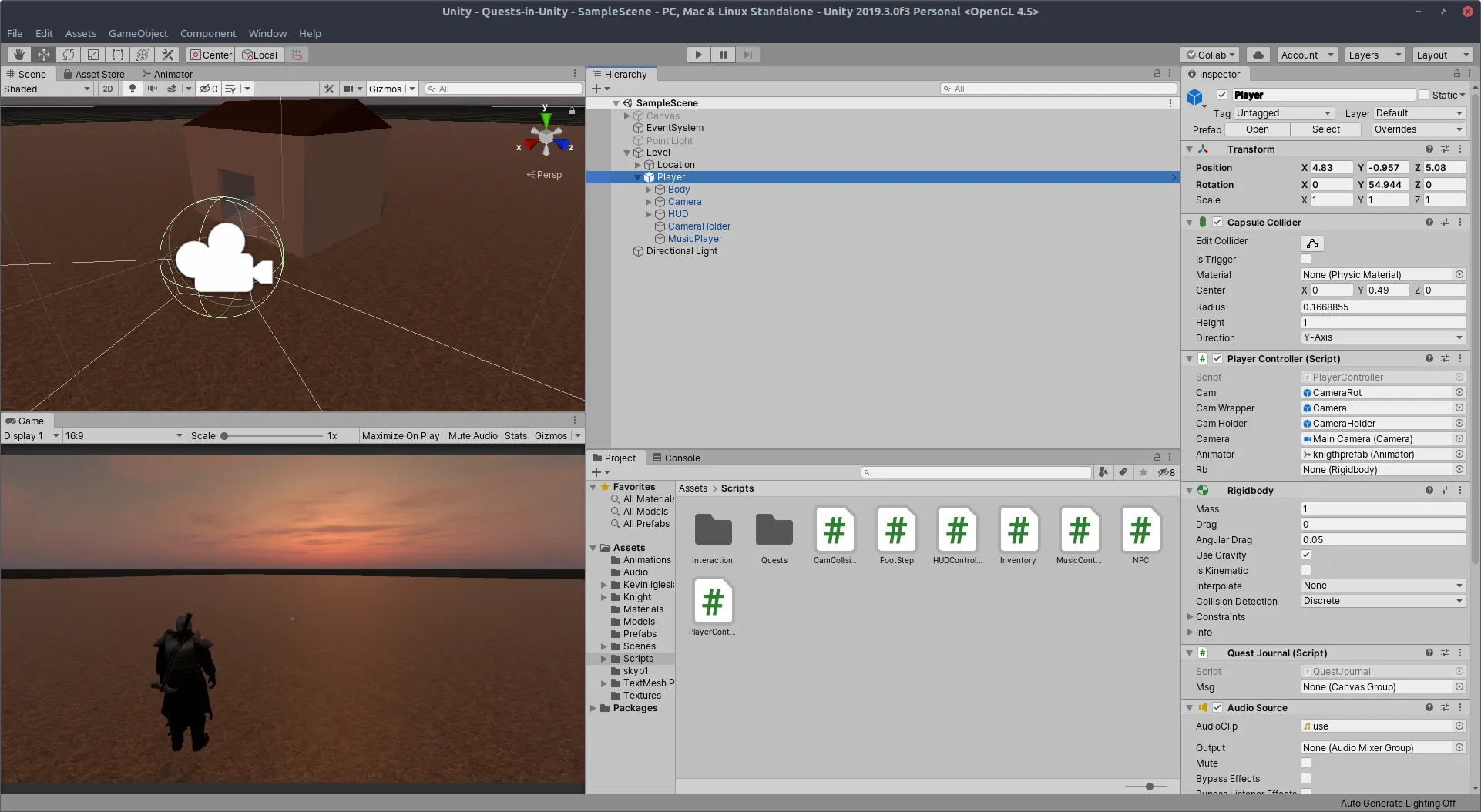
In the upper left corner is the game scene, where users can add, move, and remove objects. Below it is the game window, which displays the final look of the game. Users can press the Play button to test the game in action.
The next step displays the scene's object hierarchy, a file manager, and the Inspector tab, which displays various settings for the selected object. You can also access the project settings to configure gravity, lighting, shadows, graphics quality, and other important parameters. These tools help optimize project work and allow for more precise adjustments to the scene's visual and physical characteristics.
The engine supports scripts and an API, greatly simplifying game development. Scripts allow you to create commands that run continuously or react to player actions. The API, in turn, simplifies the scripting process, eliminating the need for complex mathematical calculations to change the position or rotation of objects. For example, instead of complex formulas, you can use a simple command such as "Unity, rotate object A 5 degrees along the X axis." This makes development more accessible and efficient, allowing you to focus on the creative aspects of gameplay.
You can choose between using a ready-made engine or developing your own. Each of these options has its advantages and disadvantages. Ready-made engines offer quick setup and ease of use, while creating your own allows for complete control over functionality and design. It's important to carefully evaluate your needs and resources before making a decision. The benefits of using a product or service include many aspects that make it attractive to consumers. First, high efficiency ensures quick results, saving time and resources. Second, accessibility and ease of use allow users to easily integrate the product into their daily work. High quality also guarantees durability and reliability. Furthermore, an attractive price makes the product accessible to a wide audience. Don't forget about the manufacturer's support, which helps users resolve any issues that arise and maximize the benefits of using it. Overall, all these advantages make a product or service competitive in the market and contribute to its popularity among consumers. A ready-made engine is the optimal solution for those who want to launch their project without having to develop it from scratch. Using a ready-made engine can significantly reduce the time and resources needed to create a website or application. These systems already include the basic functions necessary for operation, such as content management, user interfaces, and integration with various services.
The choice of a ready-made engine may depend on the specifics of your project. There are popular platforms that offer a wide range of settings and customization options. Ready-made engines also provide regular updates and support, making them a reliable choice for businesses.
Using a ready-made engine allows you to focus on content and marketing, rather than wasting time on technical development details. This is especially important for startups and small businesses that want to quickly enter the market and attract customers.
Thus, a ready-made engine is an effective tool for creating and managing web projects, allowing you to achieve your goals with minimal costs.
- Everything is already done for you - you just need to use ready-made tools to implement your ideas.
- There is a community - other developers who use the same engine can help you. Some write articles or make videos for YouTube, and you can also ask a question on StackOverflow.
- Most engines allow you to port a game to another platform in a couple of clicks. Sometimes you need to tinker with it - for example, adapting controls for a touchscreen or gamepad.
- There are free options - download and go straight to battle.
- Many engines have stores with ready-made scripts, models, effects, and other useful things.
A custom engine is a content management system developed specifically for the unique needs of a user or company. It allows you to create a web application from scratch, which allows you to take into account all requirements and wishes. Using a custom engine provides a high degree of customization and optimization for specific tasks, which is often unavailable in ready-made solutions. Such engines can be more productive and secure, as they do not contain unnecessary functionality and vulnerabilities inherent in many popular CMS. When choosing a custom engine, it is important to consider the experience of the developers, since high-quality implementation requires in-depth knowledge of web technologies. Creating your own engine also allows for integration with other systems and services, which significantly expands the functionality of the web resource.
- Maximum freedom.
- Tailored to your needs: you decide what will be in your engine.
- Good optimization: the absence of unnecessary modules makes the game easier.
- Intuitive: you will navigate the engine with your eyes closed.
The disadvantages of using certain technologies or products can significantly influence consumer choice. One of the main disadvantages is the high cost, which can limit accessibility to a wide audience. It's also worth noting the difficulty of use, especially for beginners, which can cause additional difficulties. A lack of support or updates is common, leading to product obsolescence and reduced functionality. Finally, some technologies may not meet security requirements, posing risks to users. When choosing a technology or product, consider all potential downsides to avoid a negative experience.
A ready-made engine is pre-developed software designed for creating and managing websites or applications. It includes all the necessary components to launch a project, significantly simplifying the development process. Using a ready-made engine saves time and resources, as many features are already implemented and tested. Choosing the right engine depends on the specifics of your project, its scale, and functional requirements. Ready-made engines often offer a wide selection of templates and plugins, allowing you to customize your site to your needs. Using a ready-made engine is the optimal solution for those who want to quickly launch their project without the need for in-depth technical training.
- Sometimes you may encounter bugs that are impossible to fix except by waiting for the engine authors to fix them.
- Less freedom.
- You agree to the license - sometimes you have to share a part of the profits.
- The authors may abandon or redesign your favorite engine.
- There is a lot that you will never need - and this inflates the size of the game.
A custom engine is a content management system created from the ground up to meet the specific needs of a project. This approach allows you to develop unique features and optimize the site's performance, making it more efficient. Using a custom engine gives you complete control over all aspects of the site, including security, scalability, and user interface. This is especially important for businesses that require customized solutions to stand out from the competition. Furthermore, a custom engine can be adapted to SEO requirements, which helps improve search engine visibility and attract the target audience. Choosing a custom solution requires a significant investment of time and resources for development, but in the long run it can justify itself due to the high degree of customization and efficiency.
- Long.
- Expensive.
- Requires a lot of knowledge.
- Design errors can bury not only the game, but also the engine itself.
- Additional porting costs.
- Unity;
- Unreal Engine 4;
- CryEngine 3;
- Source, Source 2;
- Creation Engine;
- Godot;
- Cocos2D;
- Game Maker Studio 2;
- RPG Maker and others.
However, you can do without a game engine if your game is small, for example, a browser game or a simple platformer. Such projects can often be implemented using basic web development technologies, saving time and resources.
Programming languages allow you to create instructions for a computer by formulating conditions and commands. For example, if condition A is met, action B should be performed, and if condition C is met, then action D. Although modern engines automate a significant portion of processes, programming still requires significant effort and in-depth knowledge. Mastering programming languages is key for a successful developer, as it allows you to create efficient and optimized solutions for various tasks.
Creating interactive elements in a game requires careful consideration of many aspects. Menu navigation, transitions between locations, character control, camera movement, music changes, dialogue, and the quest system—all these functions must be carefully programmed to ensure a smooth gameplay experience. Also important is the development of game artificial intelligence, which significantly affects the player's interaction with the surrounding world. High-quality implementation of these elements will help create a fun and immersive gaming experience.
When choosing a game engine, it is important to consider not only the engine itself, but also the programming language that is compatible with it. For example, the Unity game engine supports C# and JavaScript (in its modification called UnityScript), which gives developers flexibility in creating games. At the same time, Unreal Engine 4 (UE4) uses the C++ language, which allows you to create high-performance applications and games. Choosing the right programming language depending on the engine is a key step in game development.
- C#;
- C++;
- Java;
- Python;
- Swift;
- Objective-C;
- JavaScript;
- PHP;
- Lua and others.
You can use various programming languages to create games without using game engines. For example, JavaScript is used to develop browser games, while C++ and C# are used for desktop games. Java allows for the development of applications for Android devices. Each of these languages offers unique capabilities and tools, making game development more flexible and adaptable to your needs.
There are libraries and frameworks for working with graphics and developing games in various programming languages. A framework is the foundation of an application, to which the developer adds the necessary features, adapting it to their requirements. Such tools simplify the game development process, allowing you to focus on implementing unique ideas and mechanics rather than on basic development aspects. Choosing the right framework or library depends on the specific tasks and preferences of the developer.
The developers of Celeste chose Microsoft's XNA framework for C# instead of using traditional game engines. This decision allowed them to create a platformer with excellent controls, which became one of the key factors in the game's success. Celeste stands out for its responsive mechanics and intuitive controls, making gameplay engaging and dynamic.
Using libraries and frameworks, in addition to developing your own engine, provides the greatest degree of freedom in development. However, it is worth keeping in mind that in this case, you lose access to the graphical interface, and all settings and parameters must be specified through code. This can complicate the development process, but at the same time opens up wide opportunities for customizing and optimizing the project.
- XNA and MonoGame for C#;
- PyGame for Python;
- Pixi.JS and Babylon.JS for JavaScript;
- SceneKit and SpriteKit for Swift.
Libraries, unlike frameworks, do not offer a ready-made solution for creating an application, but provide a set of tools for developers. An example of such a library is the Math library, available in almost all programming languages. It provides functionality for performing mathematical operations, allowing programmers to focus on implementing the logic of the application, rather than on low-level calculations. Using libraries can significantly speed up the development process and improve the quality of the code, since developers can rely on proven and optimized solutions.
Using the Math library provides the ability to easily perform mathematical operations, such as raising numbers to powers, extracting roots, determining modules, and calculating sines and cosines. You don't need to implement these functions yourself; simply call the desired function and pass it the required parameters. This significantly simplifies the process of working with mathematical calculations, allowing you to focus on solving more complex problems.
Game development uses complex libraries that support graphics and physics. Graphics libraries, for example, allow you to render game objects, creating realistic environments and a striking visual experience. These tools are key to creating high-quality and immersive games.
The developer doesn't create instructions for the video card about which pixels to display. Instead, they integrate sprites (images) or 3D models into the game. The graphics library automatically calculates how these elements should be displayed on the screen. This approach simplifies the development process and increases the efficiency of working with graphics, since the developer can focus on creating content, and not on the technical details of display.

Physics libraries process data related to physics. They allow you to model phenomena such as gravity, the law of conservation of energy, momentum, and vectors. These aspects of physics are fundamental to understanding various processes and phenomena in the real world. Using physics libraries greatly simplifies the development of software that requires accurate calculations and simulations.
Similar libraries exist that allow you to work with sound and other important aspects of game development. These tools help developers effectively integrate audiovisual elements, as well as optimize the process of creating game applications. Using specialized libraries for sound and other aspects of development can significantly improve the quality of games and simplify the work of programmers.
- OpenGL;
- WebGL;
- DirectX.
- Havok;
- PhysX.
If you use any CMS or engine, then you don’t need to worry about this. Modern platforms are already optimized for convenient content management and provide the necessary functionality for effective promotion.
Which of these to choose?
If you're new to game development, it's recommended to start with a game engine. This will help you gain a deeper understanding of the game creation process. Choose one of the available engines and implement several projects to familiarize yourself with its functionality. It's also important to learn how the engine works "under the hood." Even if you have programming experience, starting with a game engine will be useful, as it will give you an understanding of the specifics of game development and the specifics of working with graphics, physics, and user interaction.
When choosing an engine for your project, consider several key criteria. First, evaluate system performance. High request processing speeds and fast page loading contribute to a better user experience and have a positive impact on SEO. Second, pay attention to security. The engine should provide protection against common vulnerabilities and be regularly updated to address identified threats.
The third criterion is support and community. Popular engines have large communities, making it easier to find solutions to emerging issues and access various plugins and extensions. The fourth important aspect is adaptability and customization. Make sure the engine allows for easy modifications and customization to suit the specific needs of your project.
Equally important is the availability of documentation and training materials, which significantly simplifies the process of learning and implementing the engine. It's also worth considering the cost of use, including possible licensing fees and hosting costs. Choosing the right engine directly impacts the success of your project, so it's worth carefully analyzing all of the above aspects.
- Community — the more people use the engine, the more actively it will be developed and the more training materials will be available.
- Released games — they can be used to evaluate the engine's capabilities.
- Complexity — the simplicity of the interface, the language used.
- Supported platforms — if you plan to make mobile games, make sure the engine you choose supports such porting.
- Focus — the name Cocos2D makes it clear that it is designed for 2D games.
If you want, you can read reviews, but they can be confusing. Many users express dissatisfaction with Unity, but the number of developers using this platform continues to grow. This indicates its demand and potential in the game development industry.
Almost all of Valve's games, including such well-known projects as Half-Life and Portal, have been developed on the Source platform. This gaming platform delivers high-quality graphics and realistic physics, making games engaging for players. Source has become the basis for numerous successful titles, confirming its importance in the video game industry.

Shooters based on the Source engine are distinguished by their high quality and enjoyable gameplay mechanics. However, this engine is also suitable for creating games of other genres. A prime example is Dark Messiah of Might and Magic, which showcases Source's capabilities in developing games with role-playing and adventure elements.

The disadvantage of this game engine is that you will not actually be developing new games, but modifications for existing projects from Valve. In addition, it does not support porting games to mobile devices or gaming consoles. It is also worth noting that the review in games is only possible from the first person. Details on the review options can be found in the article "Camera in Games: How to Tell a Story and Show the World."
Unity is one of the most popular platforms for developing modern mobile and computer games. Many successful projects have been created on this engine, including such games as:
- Mario Kart Tour;
- Life is Strange: Before the Storm;
- Superliminal;
- Mobile Legends: Bang Bang;
- Outlast and others.
One of the key advantages of this engine is support for the C# programming language. This language is highly powerful and easy to learn, allowing developers to quickly create scripts for their first projects. In addition, the engine itself has an intuitive interface and is easy to use, making it a popular choice among indie developers. Thanks to these features, beginners can quickly enter the world of game development, and experienced programmers can effectively implement their ideas.

Many people believe that it is impossible to create high-quality graphics in Unity. However, in recent years, the developers of this game engine have debunked this myth. Using modern tools and technologies such as HDRP (High Definition Render Pipeline) and URP (Universal Render Pipeline), Unity provides the ability to create stunning visual effects and realistic graphical scenes. Developers can use advanced shaders, lighting, and textures to achieve a high level of detail and saturation. Thus, Unity is becoming an increasingly popular choice for creating games with impressive graphics, allowing it to be used for both indie projects and large commercial titles.
Among game developers, it is perceived as a serious competitor to Unity. This gaming platform supports the same operating systems and provides the ability to create games in both 2D and 3D. Unlike Unity, this engine offers a wider choice of programming languages, including C#, C++, Python, Nim, D, and GDScript, which is similar in syntax to Python. This variety of languages allows developers to choose the most suitable tool for their projects, making it an attractive choice for game creation.
One of the significant advantages of this engine is its open source nature. This allows for significant improvements in its optimization and increased security. Open source allows developers to make changes and adapt the system to specific needs, which makes it more flexible and reliable.

The list of games developed using Godot is still limited, and there are practically no large or well-known projects among them. However, Godot continues to gain popularity due to its accessibility and developer-friendliness, which may lead to new and exciting games in the future.
This engine is recommended primarily for experienced programmers, as the Godot community is still small. This results in a limited number of tutorials and resources, which can hinder the learning curve and adoption of the platform.
The first game developed with the Unreal Engine was released in 1998. Since then, this powerful engine has powered numerous games, including iconic titles such as the first Harry Potter series and Star Wars: Jedi Fallen Order. Unreal Engine continues to be one of the most popular platforms for video game development, thanks to its advanced technology and ability to create high-quality graphics.

Here are some examples:
- Fornite;
- Mortal Kombat Mobile;
- Gears of War 4;
- Batman: Arkham City, Arkham Asylum and Arkham VR;
- DmC: Devil May Cry.
The game S.T.A.L.K.E.R. 2 is actively being developed on Unreal Engine 4 (UE4). A full list of information about the project is available at the following link.
The disadvantage of Unreal Engine 4 is that it uses only C++ as a scripting language, which may seem complicated for beginners. However, it is worth noting that the high demand for Unreal Engine 4 specialists significantly exceeds the need for developers on other game engines. This creates good prospects for career growth and employment opportunities for those who are ready to master C++.
Creating 2D games on Unreal Engine 4 (UE4) is a certain difficulty, since this engine was initially focused on developing 3D games. Despite this, thanks to UE4's powerful tools and capabilities, developers can adapt its functionality to create 2D projects. However, it is important to keep in mind that achieving high-quality results will require more effort in terms of setup and optimization than when using engines specifically designed for 2D games.
Unity Game Developer Profession from Scratch
You will master game development from scratch. Enhance your programming skills: learn to write in C# and create 2D and 3D games in Unity. The language is easy to learn, even if you've never coded before. This means you'll be able to develop the mobile or desktop game you've always dreamed of and land real-world projects during the course. Your dedicated manager will help you find a job at a top game studio.
Find out more