
Contents:

Project Manager: Course with Employment and a 100% Guarantee
Find out moreCritical Path Method: The Key to Successful Project Management
The Critical Path Method (CPM) is an effective tool for planning and optimizing project deadlines. This method helps identify the key tasks that must be completed to ensure the timely completion of a project. Using CPM allows for resource management and minimizing delays, which is especially important in a dynamic business environment. By applying the critical path method, organizations can improve the efficiency of their projects and ensure their successful completion within the established deadlines.
The critical path is the longest sequence of interrelated tasks in a project, the completion of which determines the overall completion date. If a delay occurs in one of the tasks included in the critical path, this immediately affects the deadlines of the entire project. Defining the critical path allows for the effective management of resources and the minimization of risks associated with task completion, which is a key aspect of successful project management.
In web development, the website layout process begins only after the design is completed, which, in turn, cannot be developed without first creating a mockup. This emphasizes the importance of the critical path, which serves as the basis for understanding the time dependencies in the project. Effective management of these dependencies allows for the optimization of task completion dates and the improvement of the quality of the final product. Proper organization of work at each stage of development contributes to the successful implementation of the project and the satisfaction of customer needs.
The critical path method allows for the efficient allocation of resources, ensuring the completion of tasks within the established deadlines. Using this method, a project manager can create a detailed schedule in which critical tasks are assigned high priority. This helps the team focus on the most important elements of the project, minimizing the risk of delays and increasing overall productivity. Proper application of the critical path method contributes to the successful management of projects and the achievement of set goals.
The critical path method was first used in the 1950s on two independent projects: the development of ballistic missiles for the US Navy and the optimization of processes at the chemical company E.I. DuPont de Nemours. Both projects encountered difficulties in meeting schedules, which became the impetus for the development of this method. Experts proposed breaking projects into individual tasks, setting their priorities and deadlines. This solution significantly improved project management and allowed for more effective achievement of set goals. The critical path method has become the basis for modern approaches to project management, ensuring resource optimization and increased efficiency.
How to Effectively Determine the Critical Path in a Project
Determining the critical path is a key element of project management, allowing for the effective optimization of time resources. Within the framework of the classical project management methodology, six main stages are distinguished: task identification, dependency analysis, creating a network diagram, estimating time costs, determining the critical path, and updating the diagram. Correct application of these stages contributes to more effective project planning and implementation, reducing completion time and minimizing risks. Using the critical path helps project managers focus on the tasks that have the greatest impact on the project completion date, thereby ensuring the successful achievement of the set goals.
To illustrate these steps, let's consider an example in which two craftsmen are assembling, installing, and securing a three-tiered shelf. This example clearly demonstrates how to effectively organize the workflow. Proper work organization not only speeds up task completion but also improves the quality of the final result. Coordinated work among team members ensures consistency and attention to detail, which is key to the successful completion of a project.
The first step in project management is identifying tasks. At this stage, it is important to compile a complete list of all activities required for the successful completion of the project. An effective tool for this purpose is a work breakdown structure (WBS), which helps divide the project into smaller, more manageable elements. This allows for a better understanding of the scope of work, distribution of tasks among team members, and more accurate resource planning. Using a WBS promotes greater transparency and control at all stages of the project, which ultimately leads to a higher level of success.
The project goal is broken down into smaller tasks, which are then subdivided into subtasks and activities. Each of these activities is documented, allowing for the creation of an overall project plan. This approach promotes more effective project management and improves control over task execution.
The process of installing a shelf can be broken down into three main stages: purchasing the shelf, assembly, and installation. Each of these stages includes important subtasks that help form a complete list of necessary actions for the successful completion of the work. A detailed description of each step provides clarity and simplifies the process, which is especially important for those who are going to install the shelf themselves.

The next step is dependency analysis. At this stage, you need to identify the interrelationships between tasks and establish the sequence of their execution. This helps eliminate confusion and increases the predictability of the process. Proper dependency analysis ensures effective project management, allowing you to optimize resources and minimize risks.
To identify dependencies, it is important to ask yourself a few key questions. These questions will help you gain a deeper understanding of the nature of dependencies and the impact they have on your life. Consider the following: What situations or emotions trigger your urge to turn to habits or substances? What are the consequences of these dependencies on your health, relationships, and overall well-being? What alternative strategies or actions can help you cope with these dependencies? Answering these questions can be the first step to recognizing the problem and solving it.
- Which task must be completed before this one can begin?
- What must be completed concurrently with this task?
- Which tasks require completion immediately after this one?
In this situation, securing the shelves is impossible without first assembling the frame. However, the frame cannot be assembled until the shelf is delivered. Therefore, the optimal sequence of actions is as follows: first, deliver the shelf, then assemble the frame, and then secure the shelves. This logical sequence will allow for an efficient installation process and ensure the structural integrity.
Creating a network diagram is an important step in visualizing a project plan. This diagram helps visually display the sequence of tasks, taking into account their dependencies. The process begins with the first task and ends with the last, which allows for a clear understanding of the project structure and timeframe. Using a network diagram promotes more effective project management and helps identify potential bottlenecks in the process.
A network diagram can be created either manually or using online services such as Canva. When developing a diagram, it is necessary to include all operations, and arrows visually indicate the sequence of their execution. This approach allows you to effectively plan and manage projects, providing visibility and structure to processes.

During work on a project, Floating tasks that are not strictly dependent on other tasks may appear. Although their implementation can be postponed at first glance, this can negatively impact the overall project timeline. Ignoring such tasks can lead to delays and increased workload for the team in the future. Therefore, it is important to consider floating tasks in project planning and management to avoid potential problems and ensure the timely completion of all work stages.
Cleaning walls is a task that can be performed at any time. However, postponing this work until the framing stage can lead to increased project timelines. It is recommended to avoid completing unfinished tasks at the last minute to optimize the process and avoid delays.
To reduce risks, it is necessary to define clear dependencies for each activity in the network diagram. Establishing such dependencies improves project planning and management, as well as increases its success. Proper organization of activities in the network diagram helps avoid delays and misunderstandings, ensuring the smooth execution of all project stages.
The next step is to calculate the time required to complete each task. Time can be specified in hours, days, or weeks, depending on the duration of the project. It is recommended to select a single unit of measurement, such as hours, for all tasks. This will allow you to more accurately estimate the total amount of work and simplify planning and time management in the project.
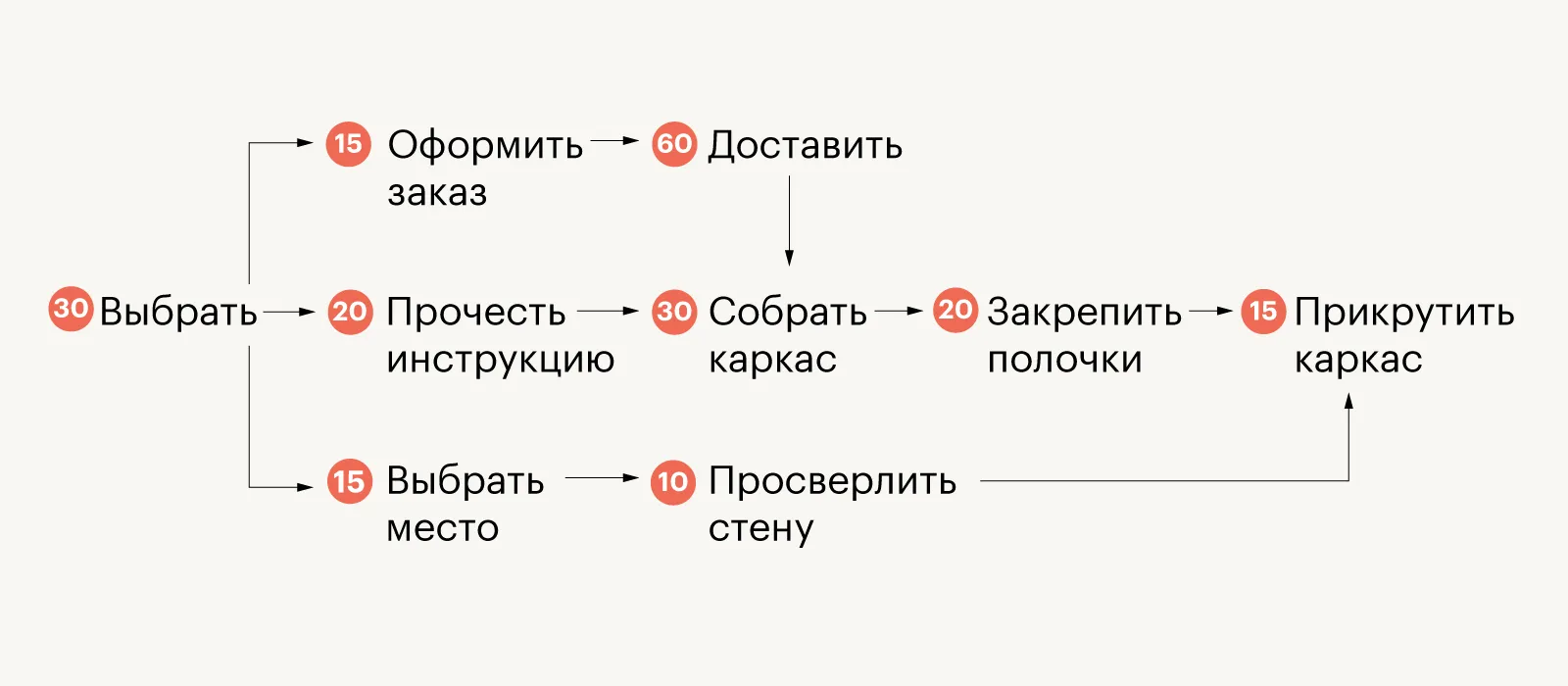
On At this stage, it is important to specify the start and end dates for each task. This will allow for optimal resource allocation and determine which tasks can be completed simultaneously. Clear planning of deadlines contributes to increased efficiency and improves project control.
Determining the critical path involves identifying the longest sequence of tasks in the network diagram. The path length is determined not by the number of tasks, but by the time required to complete them. The critical path is an important project management tool because it helps determine the minimum project completion time and identify tasks whose delays will delay the entire project. Correctly identifying the critical path allows for more effective resource planning and time management.
If two consecutive tasks require completion within two weeks, and the remaining ten tasks can be completed in just three days, then the critical path is two weeks. This means that the time required to complete the longest tasks determines the overall project duration. The critical path is an important aspect of project management because it helps identify key tasks on which the success of the entire process depends. Understanding the critical path allows for more effective time and resource planning, ensuring project completion on time.
The critical path on a network diagram is indicated, for example, by changing the color of the arrows. The total completion time of tasks on the critical path determines the project's completion date. Defining the critical path allows you to manage time resources and optimize processes, which contributes to the successful completion of the project within the established deadlines.

Certain projects may have multiple critical paths, increasing their sensitivity to change. Such projects require special attention to ensure their timely completion. Effective time and resource management becomes key in such cases, as any delays can have significant consequences for the entire project. Therefore, it is essential to carefully plan and control each stage of the project to minimize risks and ensure the successful completion of all tasks.
Updating the diagram is an important step in obtaining an up-to-date assessment of the project's status. Regular updates should be performed whenever changes occur in the project, such as the addition of new tasks or delays to existing ones. This allows the team to quickly respond to changes and adjust plans, ensuring effective project management. An up-to-date diagram helps visualize the current status and improves communication between project participants.
Significant changes can cause the critical path to change, either increasing or decreasing in length. This can significantly impact the project's timing and overall effectiveness. Changes to the critical path require careful analysis, as they may necessitate a revision of schedules and resources. Optimizing the critical path is a key aspect of project management, allowing you to minimize completion time and increase the likelihood of successful completion.
In practice, most projects face unforeseen circumstances. Therefore, regularly updating the diagram and recalculating the critical path are important aspects of effective project management. These processes help identify potential delays and optimize resources, which contributes to the successful completion of the project on time. Updating the diagram and the critical path allows the team to better adapt to changes and minimize risks, which is a key factor in achieving the set goals.
Critical Path: How to Ensure Its Successful Completion?
Project management requires careful attention to the tasks on the critical path. These key milestones must be completed on time to avoid schedule slippage. Effective tools for achieving this goal include KPIs, clear deadlines, and stage-by-stage progress monitoring. Experienced project managers use a variety of methods to maintain the necessary momentum. Implementing a systematic approach to monitoring and evaluating task performance helps improve the overall effectiveness of project management.
It's important to be mindful of tasks outside the project's critical path. Delays in their completion can have undesirable consequences. The longer you delay such a task, the higher the likelihood that it will become critical, which in turn will affect the overall project duration. Effective management of all tasks, even those not on the critical path, is key to the successful completion of the project on time.
Let's consider a practical example in the furniture assembly industry. One specialist is responsible for selecting and ordering a shelf, as well as for its delivery, assembly, and installation. Meanwhile, another specialist selects the installation site, drills the walls, and studies the instructions to provide the necessary assistance to the first specialist. This approach streamlines the furniture assembly process, ensuring high quality work and customer satisfaction.
According to the network diagram, the second specialist has ten minutes to drill the wall. If this process drags on for three hours, it will delay the first specialist, who will not be able to complete the frame installation on time. Ultimately, the drilling task will become critical and will negatively impact the entire project deadline. It is important to strictly adhere to timelines to avoid delays and ensure the efficient completion of all stages of the work.
Additional resources from Skillbox Media are useful tools for project managers. These tools will help optimize workflows, improve planning, and increase the effectiveness of teamwork. Skillbox Media offers a variety of solutions that can be adapted to the needs and scale of projects. Using these resources allows project managers not only to improve results but also to reduce the risks associated with task and resource management. It is important to use modern tools to remain competitive and achieve your goals.
- VUCA model: how to adapt to market instability
- Gantt chart: effective project planning
- BCG matrix: project evaluation by success criteria
- MVP: creating a minimum viable product
- Ishikawa methodology: identifying the root causes of problems
Project Manager: 5 Steps to a Successful Career
Want to become a valuable specialist? Find out how to develop your career as a project manager in just six months!
Find out more