
Contents:
- Abraham Maslow: The Founder of Humanistic Psychology and His Key Theory
- Maslow's Hierarchy of Needs: An Overview of Key Aspects
- The Structure of Maslow's Hierarchy of Needs
- Is It Possible to Skip Levels of Maslow's Hierarchy of Needs?
- Application of Maslow's Theory in Management: Current Aspects
- Application of Maslow's Pyramid in Marketing Strategies
- How to Apply Maslow's Pyramid to Increase Employee Motivation
- Understanding Maslow's Pyramid: Basics and Application

Internet Marketer: Get Free Access to the Course!
Learn MoreAbraham Maslow: The Founder of Humanistic Psychology and His Key Theory
Abraham Maslow was a prominent American psychologist who had a significant influence on psychological science in the mid-20th century. He founded humanistic psychology, an approach that emphasizes the uniqueness of the human personality and its development. Maslow is known for his hierarchy of needs, which describes human motivation through various levels of needs—from basic physiological to high levels of self-actualization. His work continues to be relevant and influences modern approaches in psychology, education, and management. Understanding Maslow's principles provides a deeper understanding of motivation and personality development, making his contribution to psychology invaluable. Abraham Maslow conducted a profound analysis of human behavior and developed the concept of a universal hierarchy of needs. This theory, known as Maslow's hierarchy, was first presented in his seminal work, "A Theory of Human Motivation," published in 1943. In this work, Maslow describes how human needs are organized into a pyramid, with basic physiological needs at the base and higher needs, such as self-actualization, at the top. The idea that satisfying basic needs is a prerequisite for striving for higher goals has become the basis for much research in psychology, sociology, and even business. Understanding Maslow's hierarchy of needs helps not only with personal development but also with creating effective management strategies and motivating employees. Interestingly, Abraham Maslow did not use traditional research methods such as surveys or experiments. His theory of the Hierarchy of Needs was developed by analyzing the biographies of outstanding individuals, including Thomas Jefferson, Abraham Lincoln, Aldous Huxley, and Albert Einstein. Maslow noticed that these individuals experienced similar life stages on the path to self-actualization, which became the basis for the development of his psychological theory. Studying their lives allowed him to identify key factors that contribute to achieving the highest levels of personal development and need satisfaction. According to Maslow's theory, consistent need satisfaction plays a significant role in achieving success and personal growth. In his model, needs are structured into levels, beginning with basic physiological needs and ending with the need for self-actualization. This hierarchy of needs illustrates how satisfying the lower levels creates the foundation for developing higher levels, which ultimately contributes to the full development of an individual's potential. Understanding this model allows for a better understanding of which needs must be met to achieve harmony and success in life.
The hierarchy of needs consists of five levels: physiological needs, safety needs, social needs, esteem needs, and self-actualization needs. A person can achieve higher goals and maximize their potential only after satisfying all basic levels. Successfully overcoming each level contributes to personal development and an improved quality of life.
Maslow's Hierarchy of Needs: An Overview of Key Aspects
The hierarchy of needs, developed by Abraham Maslow, is a visual representation of his theory of the hierarchy of human needs. Although Maslow himself did not use graphic diagrams to illustrate his concept, the idea of representing needs as a pyramid was first proposed by psychologist Charles McDermid in 1960, six years after the publication of his work "Motivation and Personality." This model helps better understand how different levels of needs influence human motivation and behavior. Understanding the hierarchy of needs allows for a deeper analysis of the psychological aspects of personality and their impact on social interactions. The pyramid of needs consists of five levels, beginning with physiological needs at the lowest level and ending with self-actualization at the top. This model illustrates the importance of satisfying basic needs to achieve higher goals. Understanding this hierarchy helps us realize that successful self-development and achieving personal ambitions requires first meeting our fundamental needs.
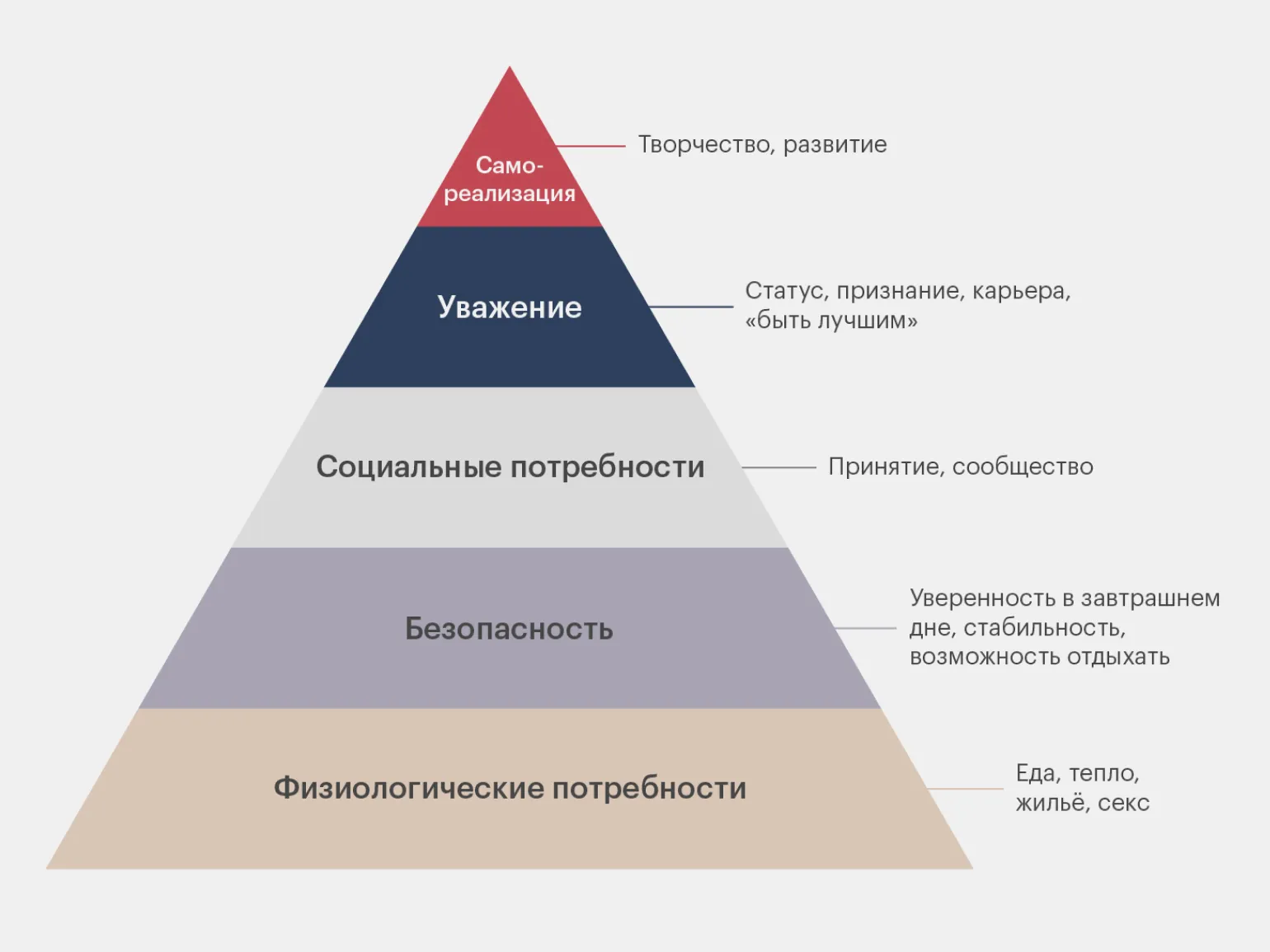
Maslow's Hierarchy of Needs Structure
Psychologist Abraham Maslow created a model that classifies human needs into five levels, organized in a pyramid. This hierarchy illustrates the impact of satisfying basic needs on human behavior and motivation. According to this model, before a person can satisfy higher needs, they must first satisfy the needs at the lower levels. Understanding this hierarchy helps us better understand how different needs affect personal and social aspects of life, as well as decision making.
This structure allows us to analyze how different needs interact and influence each other. Let's take a closer look at each level.
At the most basic level are physiological needs, which are essential for survival. These vital needs include food, water, air, sleep, and reproduction. People instinctively seek to satisfy these primary needs before moving on to higher levels of needs. Satisfying physiological needs is the foundation for further development and achieving more complex goals in life.
The second level of the pyramid of needs consists of the needs for security and stability. This includes both physical safety and the protection of financial and material assets. A person who does not feel safe is unable to focus on creativity and self-realization. A stable sense of security is the foundation for achieving higher needs, such as personal growth and self-expression. Without this foundation, developing potential and striving for success become extremely difficult.
After satisfying basic needs, the stage of social needs begins. During this period, a person strives for communication and the formation of interpersonal relationships, including friendships and family ties. Not only caring for others becomes important, but also receiving love and support from others. Social connections play a key role in emotional well-being and overall quality of life, contributing to the formation of a sense of belonging and mutual understanding.
At the fourth level of the hierarchy of needs, a person begins to experience a need for respect and recognition. These needs can be realized through educational achievement, career advancement, or active participation in social projects. Awareness of one's own value and recognition from others play a key role in the formation of self-esteem and social identity. It is important that everyone has the opportunity to demonstrate their abilities and receive positive recognition in society, which contributes to their personal and professional development.
At the top of the hierarchy of needs is self-actualization—a key process in which a person discovers their unique talents and strives for personal development. This is manifested through creativity, altruism, and philanthropy. According to Abraham Maslow's theory, self-actualization represents the highest goal of human life, the desire to achieve one's potential and realize one's dreams. This process not only contributes to an individual's quality of life but also has a positive impact on society as a whole. Self-actualization involves recognizing one's abilities and finding and pursuing one's passions, which leads to harmony and satisfaction in life.
In his later works, Abraham Maslow introduced the level of transcendence, which he describes as a state in which a person overcomes his own limitations. This state is accompanied by profound spiritual changes and a sense of unity with the surrounding world. However, achieving this level remains rare.
Is it possible to skip levels of Maslow's hierarchy of needs?
Abraham Maslow's theory of needs is a key element in the study of human motivation. Many believe that in order to move to the next level of needs, the previous ones must be fully satisfied. However, Maslow did not make such a statement. He emphasized that people often try to satisfy several needs simultaneously, rather than limiting themselves to just one. This understanding allows for a deeper appreciation of the complexity of human motivation and the diversity of factors influencing behavior.
Changes in life circumstances, such as moving, a new job, or having a child, significantly impact a person's priorities. Having children, for example, forces parents to rethink their values and needs, which can lead to changes in goals and habits in life. Such transformations require adaptation and can become the impetus for personal growth, the formation of new interests, and a rethinking of relationships with others.
In his research, Abraham Maslow emphasized that achieving a certain percentage of satisfaction is sufficient to advance to the next level of the hierarchy of needs. For example, physiological needs must be satisfied at 85%, safety needs at 70%, social connections at 50%, recognition needs at 40%, and self-actualization requires only 10%. These findings suggest that complete need satisfaction is not a strict requirement for achieving higher levels of development.
Maslow emphasized that his needs model is not universal and does not cover all people. He identified certain categories of individuals whose needs do not correspond to his hierarchy of levels. These categories include:
- People for whom self-esteem is more important than love.
- Creative individuals who put art and creation above all other needs.
- Survival-oriented individuals whose priorities are limited to basic needs such as food and shelter.
- People with mental disorders or sociopaths who have no interest in social interactions.
- Individuals who do not understand the importance of security, since they have never encountered a lack of resources.
- People who strive to achieve goals at any cost, whom Maslow called "martyrs", willing to sacrifice comfort for the sake of results.
Application of Maslow's theory in management: current aspects
Abraham Maslow, a famous American Maslow, a psychologist, developed the famous hierarchy of needs, which is widely used in business and management. In his 1965 work, "Eupsychic Management," also known in Russia as "Maslow on Management," he emphasizes that effective management requires not only financial incentives but also satisfying the higher needs of employees. Maslow emphasizes that achieving maximum productivity and motivation of employees requires considering their psychological and social needs, which in turn contributes to the creation of a harmonious work environment.
Recent research shows that companies that consider the needs of their employees at all levels of Maslow's hierarchy demonstrate higher productivity and talent retention. Gallup data confirms that 70% of employees who are satisfied with their work experience increased productivity. By paying attention to the needs of their employees, organizations can significantly improve their performance and create a positive work atmosphere.
Maslow's hierarchy, originally developed to understand human needs, has found wide application beyond management. Her followers have successfully adapted her concept to marketing and personal life. It is important to understand that both businesses and individuals have needs that transform at different stages of their development. This awareness allows for more effective development of strategies that address the current needs of the target audience and contribute to the successful development of both companies and personal relationships.
For successful business, it is crucial to determine the level of Maslow's hierarchy of needs your company ranks on. This knowledge allows you to select effective strategies and tools for development. For example, marketing methods used in the early stages differ significantly from those used in more mature companies. Understanding your position in this hierarchy helps you adapt your approaches to customers, improve the effectiveness of advertising campaigns, and optimize resources. Thus, analyzing Maslow's hierarchy becomes an essential step in achieving sustainable growth and competitiveness in the market.
Using complex marketing strategies in the early stages of business development can be ineffective, especially when the main goal is to test the market and confirm product demand. At the same time, if a company already has all the necessary tools for promotion, ignoring their use is inappropriate. Instead of relying on random methods, it is worth focusing on a systematic approach to marketing, which will allow you to optimally use available resources and increase the effectiveness of promotion.
Understanding the level of your business in Maslow's hierarchy of needs helps you make more informed decisions. This opinion is expressed by Petr Doronin, Commercial Director of Multiways. By analyzing your company's position in this model, you can better assess customer needs and determine development strategies. This knowledge will help you not only improve internal processes but also create more effective marketing strategies aimed at satisfying the needs of your target audience.
Using Maslow's Hierarchy of Needs in Marketing Strategies
Maslow's hierarchy of needs is an important theory of motivation that helps you better understand customer needs. Understanding these needs can become an effective marketing tool, allowing you to more accurately determine what exactly your potential customers are looking for. Understanding this theory helps develop strategies that effectively address target audience needs, improving customer engagement and increasing customer satisfaction. By applying the hierarchy of needs in marketing, companies can create more targeted offers and build customer loyalty.
If your company offers express laptop repair services, it's important to consider that customer needs extend beyond basic physical needs. In this case, the emphasis should be on safety and reliability. Customers seek prompt repairs because their laptop is likely a key tool for both work and personal life. Quickly restoring the device's functionality allows them to avoid wasted time and financial losses, highlighting the importance of high-quality and timely laptop repair services.
To successfully promote repair services, it's important to emphasize the speed of work. For example, you can use wording like: "We'll find out the cause of the breakdown in just one hour, fix it in three" or "Bring your device today - get it repaired tomorrow with a six-month warranty." Fast and high-quality repairs attract customers and contribute to a positive company image.
Milya Kotlyarova, founder of Digital Broccoli and content marketer at Solvery, claims that Maslow's Hierarchy of Values is an effective tool for developing a brand's content strategy. It helps determine which customer needs a product satisfies and which aspects should be emphasized to increase engagement and sales. Using this model allows for a deeper understanding of the target audience and tailors content to their needs, which in turn fosters brand loyalty and interest.
It's important to consider that the same product can satisfy multiple needs simultaneously. For example, healthy food can satisfy the need for safety by offering gluten-free and lactose-free options for those with intolerances. Furthermore, such food can promote a sense of community and satisfy aesthetic needs if the dishes are appealing for social media posting. This underscores the importance of taking a holistic approach to product selection and understanding their role in consumers' lives.
The needs we strive to satisfy significantly influence the content and values we present. For example, creating stylish photos and videos can inspire our customers. We may invite doctors and nutritionists to discuss product ingredients and provide nutritional advice. It's also important to build communities of like-minded people who support a healthy lifestyle and share experiences. This approach allows us not only to attract attention but also to build trust with our audience, which in turn helps increase loyalty and strengthen the brand.
Applying Maslow's theory to marketing also includes analyzing changes in customer needs. During the COVID-19 pandemic, there was a significant shift in priorities. The need for safety came to the forefront, and customers who had previously focused on self-fulfillment began actively seeking essential goods and protective equipment for themselves and their loved ones. This shift highlights the importance of understanding the dynamics of consumer needs and adapting marketing strategies to the current conditions.
During the COVID-19 pandemic, there was a significant increase in demand for testing that can be performed without a visit to a medical facility. Laboratories quickly responded to these changes and began offering at-home PCR testing. This solution ensured patient safety by minimizing the risk of infection and made the testing process more accessible and convenient. Home testing has become an important step in the fight against the spread of the virus, ensuring timely diagnosis and the ability to quickly respond to the disease.

Subscribe to our telegram channel dedicated to digital marketing and management, where we publish useful books, Current materials and industry news. Here you will also find information about free events and the opportunity to get tickets to them. Join our community of professionals and stay up to date with the most important events in the world of digital technologies.
How to apply Maslow's pyramid to improve employee motivation
Effective HR management is based on a deep understanding of employee needs, and in this context, Maslow's pyramid becomes an indispensable tool. For successful management, it is important to determine at what level of the hierarchy of needs each employee is. Motivation methods should be adapted in accordance with this level, which will improve team satisfaction and productivity. It is recommended to study authoritative sources for more detailed recommendations on the application of Maslow's theory in HR practice.
We conducted a survey among HR specialists, coaches, and entrepreneurs about how they apply Maslow's pyramid in their professional practice. The study revealed a variety of approaches to integrating this motivation theory into work processes and development strategies. Many experts note the importance of understanding employee needs at different levels of the pyramid, which helps build more effective teams and improve employee satisfaction. Implementing Maslow's pyramid principles helps not only in HR management but also in developing training and professional development programs, ensuring the harmonious development and growth of both employees and the company as a whole. Anton Volkov, co-founder of Solvery, believes that Maslow's pyramid effectively illustrates the career path of specialists. In the IT sector, many professionals strive for development at various stages of their careers. The steps of the pyramid, from the second to the fifth level, reflect the needs for security, socialization, and recognition. Our company supports them in this process, making it look like an exciting game.

Starting a Career in IT For many, it's associated with a desire for stability and a comfortable work environment, notes expert Volkov. It's important to build a knowledge and skill base that will facilitate further professional development. IT newcomers should focus not only on technical aspects but also on developing soft skills, which will significantly increase their competitiveness in the labor market.
At the initial stages of a career, when a specialist acts as a junior, it's important to focus on two key aspects: recognition and development. These factors play a critical role in professional growth, allowing young specialists not only to improve their skills but also to receive well-deserved recognition for their achievements.
Maslow's pyramid is a useful tool for young managers, allowing them to determine the developmental stage of their employees. The first two levels of the pyramid focus on satisfying basic needs for safety and physiology, which create the necessary foundation for further development. Once these needs are met, managers can move on to higher levels, such as social needs, esteem, and self-actualization. Understanding this structure will help improve team motivation and performance.
Recognition, respect, and self-actualization represent infinite levels of needs, as Maslow notes and my personal experience confirms. These needs not only influence employee development but also play a key role in the company's successful advancement. Understanding and satisfying these needs helps build a motivated and productive team, which, in turn, positively impacts the achievement of business goals. Investing in the personal and professional development of employees is an important aspect of strategic management, allowing a company to remain competitive in the marketplace.
In Russia, employee development is perceived not only as a goal but also as an important tool for achieving strategic business objectives. A well-developed team is capable of achieving high results faster, which directly impacts the success of the organization. Therefore, working with employee recognition and self-actualization levels is especially important. Effective employee development not only increases productivity but also improves corporate culture, which in turn strengthens the company's competitive position in the market. Investing in employee training and development is a strategic step that helps organizations adapt to changing conditions and achieve sustainable growth.
At these organizational levels, companies have the opportunity to expand their employees' areas of responsibility, which facilitates horizontal growth. Although vertical growth associated with promotions also occurs, many companies prefer flat organizational structures. They use career matrices to expand the scope of responsibilities and develop employees' professional skills. This not only increases motivation but also improves overall team performance.
Vadim Ruban, a human resources management expert and coach, emphasizes the importance of understanding employee needs for building a highly effective team. Understanding these needs not only improves the work atmosphere but also increases employee engagement and productivity. Effective teamwork and consideration of their interests contribute to the achievement of the company's overall goals and strengthens corporate culture.
Yulia Kopylova, a mentor at Solvery, applies Maslow's pyramid model in one-on-one meetings. She notes that employee motivation can sometimes decline. Although basic needs are generally met, newcomers often face difficulties adapting to the team. In such situations, team building mechanisms become effective, including collaboration and strategy sessions, which help strengthen team spirit and increase employee engagement.
For experienced employees, increased motivation can be achieved through completing challenging tasks, which satisfies their need for recognition. Training-related solutions, such as recommendations for professional development programs or specialized literature, are also effective measures. This not only promotes personal and professional development but also strengthens their commitment to the company.
Maslow's hierarchy of motivation is a useful tool for understanding motivation, but Ulugbek Kamolov, founder of UniStudy, notes its limitations. He emphasizes that the company provides employees with basic needs through bonuses and incentives and actively supports their professional development. As an example, he cites a case where UniStudy helped an employee obtain an education in the United States by providing leave for study. This approach not only promotes employee development but also improves overall team effectiveness.
Kamolov emphasizes the importance of training and development for increasing employee satisfaction. This, in turn, contributes to improved performance and strengthens the company's HR brand. Investing in employees' professional growth not only increases their motivation but also creates a positive image of the organization in the labor market.
Maslow's hierarchy of needs, despite its popularity, does not always take into account employees' personal goals and their interactions within a team. A persistent pursuit of development for overloaded employees can be ineffective. In such situations, it is important to focus on support and solving current problems using more adaptive methods, as Maslow's approach may be insufficient for a full understanding of employees' motivation and needs. Alternative approaches to management and personnel development can ensure more effective resolution of emerging issues and more harmonious interaction within a team.
Understanding Maslow's Hierarchy of Needs: Basics and Application
Abraham Maslow's hierarchy of needs is a key concept in the field of psychology that illustrates the process of satisfying human needs. According to this theory, needs are organized into levels, ranging from basic physiological needs such as food and safety to more complex desires, including social connections, esteem, and the pursuit of self-actualization. This model helps understand the motivations behind human behavior and is a useful tool for analyzing personal and professional goals. Understanding Maslow's structure of needs can be useful not only in psychology but also in marketing, management, and other fields where human motivation is important. At the most basic level are physiological needs, including food, water, and sleep. Next are safety needs, which encompass stability and protection. Next come social needs, such as the desire for belonging and friendship. These are followed by the need for recognition, which reflects the desire for respect and appreciation from others. The final level is self-actualization, characterized by the desire to achieve personal growth and realize one's potential. These levels of needs provide a foundation for understanding human motivation and behavior.
Maslow's theory posits that people strive to first satisfy their basic needs, such as food, water, and safety. However, in real life, this order can shift. Under stress or crisis, self-actualization needs, such as self-expression and achieving personal goals, can become more important than satisfying basic needs. This demonstrates that human motivation is complex and multifaceted, and does not always follow a linear hierarchy. Understanding these nuances is important for psychologists and HR professionals, as it can influence approaches to motivating and maintaining well-being in various situations.
Maslow's concept of needs finds application in various fields, such as marketing and HR management. In marketing, this theory is used to fine-tune advertising offers to meet the specific needs of the target audience. In HR management, it promotes a deeper understanding of employees and the creation of conditions for their satisfaction and motivation. Applying Maslow's model helps companies develop strategies that meet customer and employee expectations, which in turn improves business performance and promotes growth.
Maslow's theory, based on personal observations, has its limitations in generality due to the lack of empirical data. This highlights the fact that, despite the model's usefulness in various contexts, predicting human behavior based solely on its principles is not always possible. Thus, it is important to consider that individual differences and cultural characteristics can significantly influence people's motivations and needs, which makes Maslow's theory only one tool for understanding human behavior.
Internet Marketer: 5 Steps to a Successful Career
Want to become an internet marketer? Learn 5 key skills for a successful career! Read the article.
Find out more