
Contents:

Skillbox Country Marketing Specialist CIS.
Studies local markets and develops promotion strategies for the Skillbox brand in the CIS countries. Implements special projects with partners and works with influencers.
Skillbox Marketing Specialist in the CIS countries.
Studies local markets and develops promotion strategies for the Skillbox brand in the CIS countries. Implements special projects with partners and works with influencers.
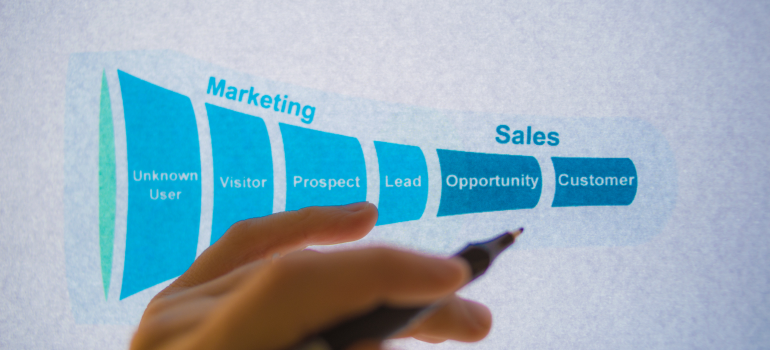
A sales funnel isn't just an abstract concept, but a powerful marketing tool. Imagine a funnel where all potential customers are at the top, and only those who have made a purchase are at the bottom. Understanding how it works is essential for the success of any business.
— A sales funnel is a sequence of steps that must be completed to purchase a product or order a service,— shares Alexandra Galygina. Understanding how a sales funnel works is important for business because it helps identify weaknesses in a sales strategy and allows you to adjust it to increase conversion.

Create a career track - choose and take a free career guidance test, get a personalized selection of courses and analyze the results with a Skillbox specialist during an individual consultation
Find out moreWhat stages does the sales funnel consist of?
Purchase of goods or order of services - a process that consists of several stages, at each of which the client experiences certain emotions. The task of the business is to ensure that he makes the “right” decision, and it is necessary to nudge him towards this at each stage of the funnel.
— The basis is the well-known AIDA decision-making model, where the target audience learns about the product, is interested in it and researches the offers, makes a purchase decision and buys,— says Alexandra. — At each stage, the client makes decisions and takes actions that bring him closer to completing the transaction. The business, for its part, needs to remember this and build a marketing strategy in such a way as to competently interact with the client.
Let's look at each stage in more detail:
- Awareness. The customer now knows about the product. How did they find out? Through various channels - advertising, a blog, social networks, search queries. It is important to immediately attract attention, making the product interesting to the target audience.
- Interest. Once the audience has learned about the product, the interest stage begins. The target audience begins to study the offer in detail, looks for additional information, reviews and compares it with alternative options. The main goal of the marketing strategy is to convince the client that your product solves their problems.
- Consideration. The client is at the stage of actively considering the offer. He studies the product in detail, compares it with competitors, analyzes the advantages and disadvantages. It is important to provide all the information and convince the client of the advantages of the offer.
- Intent.The client shows a specific interest in purchasing. He can fill out a request form, subscribe to a newsletter, communicate with company representatives to clarify details. The main task here is to convince of the need to purchase and prepare for the final decision.
- Evaluation.The consumer evaluates all aspects of the offer, including price, delivery or service terms, warranties. He compares offers from different companies and makes the final decision to purchase.
- Purchase. The final stage, when the deal is closed. It is necessary to provide the client with an easy and convenient purchasing process in order to avoid refusal at the final stage of the sale.
Why do marketers need a sales funnel?
A sales funnel helps marketers better understand the target audience, attract and retain it, optimize marketing strategies and increase sales.
"This tool helps you understand where exactly potential customers are getting lost. The sales funnel allows you to focus on improving conversion at each stage and customize marketing campaigns to the needs of each phase," explains Alexandra.

Let's take a closer look:
- Identifying the stages of the buyer's journey.The funnel helps marketers understand what stages the customer goes through before making a purchase. This allows you to adapt marketing strategies and create content that will help guide the target audience through all stages.
- Focus on promising customers.By analyzing data, marketers identify customers who are at the most advanced stages and need additional support and stimulation. This helps to allocate resources wisely.
- Develop personalized promotion strategies.Knowing what stage each customer is at, marketers can create personalized promotion strategies aimed at addressing their specific needs and overcoming obstacles on the path to purchase. This helps increase conversion and improve the overall customer experience.
- Optimizing Marketing Campaigns.Analyzing sales data allows you to evaluate the effectiveness of marketing campaigns at different stages of the customer journey. It helps you understand which channels and tactics are most successful in attracting customers and adjust your marketing efforts.
How to Analyze and Optimize a Sales Funnel
Analyzing key sales funnel metrics and optimizing them is essential for increasing the effectiveness of your marketing strategy and reducing losses.
— Methods for evaluating effectiveness include conversion tracking, analyzing metrics at each stage, studying returns and feedback, and optimization can occur through improving content, automating processes, and personalizing the buying journey, — shares the expert.
Ongoing analysis is carried out through:
- Stage-by-stage conversion measurement.Marketers track how many customers go through the stages of the sales funnel, what proportion of transitions between stages. This way, they find bottlenecks where there are problems with content or feedback.
- Using analytical tools.They help marketers track the actions of the target audience, identify factors influencing conversion, and make data-driven decisions.
- Segmentation. Dividing the target audience into segments helps analyze the effectiveness of the approach for each group separately. This identifies differences in behavior and needs in order to develop individualized strategies for each user group.
Optimization occurs through:
- Removing bottlenecks.This means improving the user experience, optimizing content, or changing strategy.
- Increasing conversion.Marketers can test different content, design, and offer variations to determine what works best to attract and retain their target audience.
- Process automation.The implementation of automated sales management systems allows marketers to more effectively track and optimize the process, minimizing manual work and reducing the likelihood of errors.
What tools do marketers use when working with the sales funnel?
Choosing the right tools is important for effective sales management and optimization. This allows companies to achieve a sustainable increase in conversion, better customer service, and more effective marketing.
— These can be CRM systems, analytics systems, platforms for testing and conversion optimization. Which ones exactly? Here, each marketer works with what is convenient for them, says Alexandra.
- CRM systems (Customer Relationship Management).Bitrix, Salesforce, HubSpot CRM and their analogues help manage contacts, track interactions with the company. And also - store information about clients, record notes about each interaction, set reminders for next steps and analyze the history of client relationships.
- Analytics tools.They provide information about user activity. They help track conversion rates, analyze traffic and interactions with online resources, and identify traffic sources. Popular ones include Google Analytics, Adobe Analytics, and Yandex Metrica.
- Marketing automation.Various platforms help automate and optimize marketing processes at all stages. They can be used to automate email sending, manage advertising campaigns, create personalized interactions with customers, and test different content options. Popular tools include HubSpot, Marketo, and Salesforce Marketing Cloud.
— Today, almost all popular tools can be easily integrated with other systems. This allows you to create a unified ecosystem for managing the sales funnel and effectively interacting between different departments of the company,— the expert shares.— At the same time, some companies prefer to develop their own tools to work with the funnel, taking into account the unique needs of the business.
Successful Sales Funnels. Let's look at examples
Each approach to sales is individual. It is important to effectively use strategies and tools that take into account the specific features of a particular business. Let's look at successful cases:
- Uber.The use of discounts and promo codes for new users, a user-friendly application interface, and customer feedback help attract and retain the target audience, increasing the number of orders.
- Onliner.Offers free delivery and various bonuses for registration and purchases to attract new customers and retain existing ones.
- Yandex.Market.Offers various promotions and discounts to attract new customers, gives personalized recommendations based on previous purchases.
- Tesla.Runs limited pre-orders, creating anticipation and motivating people to buy.
- Spotify.Attracts new users with a free plan, then offers them paid options to increase conversion.
- Amazon.Uses personalized recommendations to increase interest and engagement.
What mistakes do companies most often make when working with a sales funnel?
Today, businesses can make certain mistakes that can hinder the achievement of desired results.
— I would note a lack of understanding of the client here. To avoid this mistake, you need to study and analyze user behavior. Companies can also notice a lack of optimization. To prevent this, you need to test and study processes, — notes Alexandra. —And the biggest mistake today is the mismatch between marketing and sales. For a successful business, these teams must work in synergy.
Let's dwell on this in a little more detail:
- Insufficient understanding of customer needs.Some companies focus exclusively on selling their products or services, without considering the real needs of their audience. Solution: regular research and target audience analysis.
- Lack of content and offer optimization.If the content at each stage of the funnel does not meet user needs and requests, this can lead to loss of interest and decreased conversion. Solution: regular content testing and optimization.
- Insufficient automation and integration of processes.Manual management can lead to delays, errors, and missed opportunities. Solution: Implement CRM systems, marketing automation platforms, and other technical tools.
- Lack of continuous analysis and monitoring.Some companies forget how important it is to analyze and monitor performance indicators. Solution: Regular analysis of indicators helps to identify problem areas and take measures to eliminate them.

Why do you need a sales funnel?
The sales funnel is the main tool for effective marketing. Understanding the stages that each buyer goes through allows companies to create more targeted and effective promotion strategies.
Continuous analysis and optimization are necessary steps on the path to increasing sales and growing a loyal customer base. By regularly monitoring metrics and implementing improvements, companies can minimize audience loss and increase conversion.
— No business can do without this tool. The sales funnel helps attract, retain, and maximize customer value. Its ongoing analysis and optimization allow companies to adapt to rapidly changing market conditions and consumer behavior, ensuring business sustainability and growth, — Alexandra summarizes.
Master the profession of "Internet Marketer" with Skillbox
You will learn how to manage communities on social networks and set up targeted advertising. Understand SEO website promotion and media planning. Learn how to collect analytics and set up contextual advertising. Learn to develop digital strategies and calculate advertising effectiveness using KPIs. Build a strong portfolio of 14 projects.
Remove access